Community Driven Makerspaces and Persisting AFTER Failure- ISTE 2016 Takeaways

Screen Shot 2016-07-20 at 10.44.30 AM.png

ISTE 2016 was a whirlwind of crazy, awesome, edtech fun with amazing people! It was my first time at this international conference and I was excited to present on three different days! Thanks to Kristi Taylor for designing this awesome Scratch-inspired shirt based on my idea to have a coding shirt that would command a “program for life.” I’ll warn you now this post is tweet heavy because I’ve got to get back to writing book numero dos!

Getting Girls Involved in STEM

Diana Rendina, Bev Ball, and I did a super quick and information packed snapshot on getting girls involved in makerspaces and STEM on Monday. We feel that it is important to make space for girls and make sure they don’t get pushed out of our makerspaces by overly enthusiastic boys.

No offense guys- just think of it like ladies night- there is something empowering about getting a group of girls together. Without boys around, girls who normally experience “loss of voice” seem to gain confidence in finding their voice at school. At my own #GirlsinTech camp, most of the attendees were the perfect example of girls in high school who usually experience “loss of voice.” We identify these students as girls who get great grades, behave, and generally just sit quiet as a mouse in class. A lot of times, they get overlooked because they are so quiet.

One of the best things about holding a space for girls is that it is an awesome way to break some of them out of their shells and get them to stand out and shine! If you get 20 quiet girls together, you might think they’ll all be quiet…. but actually quite the opposite occurs! They find a solace in each other, an infectious energy will takeover the room, and pretty soon you’ll have a room of laughter, fun, and learning.


For our session, Diana, Bev, and I have very different methods for getting girls involved, so it was super cool to present with these awesome ladies. Diana and I are taking the conversation a little further by incorporating steps for getting girls involved in every chapter of our new book: Challenge Based Learning in the School Library Makerspace.

Takeaways from our Session:

  • Combine low tech and high tech
  • Incorporate free choice, craft, and experimentation
  • Set aside time for girls
  • Girls thrive on problem-solving combined with creativity
  • Create mentor partnerships so students can learn from mentors and students can become mentors!

Full slides of our presentation are available here.

This slideshow requires JavaScript.


Maker Challenge

The AmazonEdu Maker Challenge hosted by Nicholas Provenzano (aka The Nerdy Teacher) was AMAZING! Talk about a community-driven maker focused session! It was such a whirlwind experience and definitely replicable in your own makerspace. Nicholas and I co-wrote about the experience and you can read it here on the Follett Community blog.

What I loved about the experience was that it almost exactly replicated what happens in my library makerspace. We were issued a challenge: “Hack a classroom activity or procedure” and then given two hours to come up with a solution. My partner and I talked and laughed and came up with  quite a silly solution. We got into the fever of making and before I knew it, I looked up and our time was over! And I was ready to share and then make something new!

Takeaways from the Maker Challenge:

  • Go read about how the whole challenge went down on the Follett Community blog
  • Making is Messy
  • Let your community drive your makerspace
  • Include student voice and choice in all maker activities
  • Work together! Even during a Challenge!

Knights of Make-A-Lot

First, I have to tell you that I never met Nathan face to face until five minutes before our session. And I think he is one AWESOME DUDE!

This session was unlike anything I’ve ever done! While it was somewhat like a traditional panel, Nathan brought his own brand of awesomeness. I loved listening to what he said and piggybacking his thoughts. He called this, “Cliffnotes for Nathan.”

Guillermo from Tinkercad actually broadcast half of our session live here.

Takeaways from this panel:

  • Cliff Notes for Nathan: “Embrace the mess”
  • Fail Forward aka learn from mistakes and perservere through failures.
  • The key to a successful makerspace is building a maker community. It is not about the STUFF, it is about the PEOPLE!

Sparkfun Tour

On Sunday, Jeff Branson picked up me and other awesome tech educators and drove us to Boulder for a tour of BLDG61 at Boulder Public Library and then to Niwot for a tour of Sparkfun! One of my favorite things about touring Sparkun (other than that it felt like I was going to float down the chocolate river like Augustus Gloop and get lost in a sea of awesomeness) was seeing all of the cool stuff from my favorite Sparkfun tutorials! Like the actual monstie stuffie from Sew Electric, and the giant Bare Conductive Wall. The work environment was a mashup of fun, college dormroom, and well- a ton of PERSONALITY.

Boulder Public Library is one of the most beautiful and relaxing libraries I’ve ever seen! Wowza! Finding the makerspace was a bit of a scavenger hunt, but man, what a cool place! I’m so glad Janet invited us to visit! Upon arrival I found a group of people fixing a chandelier, a retired gentleman firing up the laser cutter to put his design on wooden cups he’d crafted, and was surrounded by cool stuff that the Creative Technologist had made to personalize the space. In short- it was PERFECT! BPL, converted an old workshop into a makerspace which I think is a pretty perfect way to add creativity and self-reliance to library programming.

F2FOMG

After 4 days of meeting people I knew from social media face to face, Diana and I ran into  Carrie Baughcum (aka rad sketchnoter Heck Awesome) and we all decided that we needed a word or hashtag to describe meeting your social media friends. Because there is a very interesting moment that happens when you meet someone after a session, then read their nametag and realize they are one of your favorite Twitter/Instagram/etc peeps. Read Carrie’s post about how #F2FOMG was born because it perfectly describes this energetic experience and the best thing about going to an edtech conference….. people!

And I met so many amazing people at ISTE that I have been friends with for the last year! It’s so great to finally meet and hang out in person with educators: Diana Rendina, David Saunders, Kristina Holzweiss, Nicholas Provenzano, Elissa Malespina, Sherry Gick, Kathy Schmidt, and Donna Macdonald. Super cool to meet makers: Andrew Miller from Makerspaces.com; Jie Qi and Patricia from Chibitronics; and the whole gang from littleBits– Ayah, Nick, Ted, and Christina! Plus, it’s always awesome to see Coloradans: Jeff Branson, Bev Ball, Shannon Miller, and Ashley Kazyaka!

I was so excited to meet Ayah Bdeir the founder of littleBits! She thanked me for writing the Librarian’s Guide to littleBits and everything I’ve done to promote hands-on learning and the maker movement. (That was pretty dang cool. 🙂

Other Session Highlights

I went to some amazing workshops and sessions- here are just a few highlights to entice you to go to ISTE 2017 in San Antonio!

Processing workshop and Art-Duino with Sparkfun

What a most excellent way to download a new skill- a workshop with Sparkfun educators Derek Runberg and Jeff Branson!  I loved having the time set aside to learn with these experts! One of the most important things I learned during this workshop was to comment back to myself when writing code because it helps DEBUG when you run into problems! Thank you, Jeff! This has already helped me in a few projects since I got back from ISTE!

The Art-duino workshop with Brian Huang was pretty rad too. I was able to hack the blink code for a fading effect, but I still wanna tinker with this code and make even cooler art projects with Arduino.

Pernille Rip

If you ever get the chance to hear this awesome reading educator in person…. GO GO GO! I loved every single thing she said! I can’t stress the importance enough of listening to students about reading choices, independent reading, and giving them TIME IN YOUR CLASSROOM to read, reflect, and write.

Two Guys with an Ipad

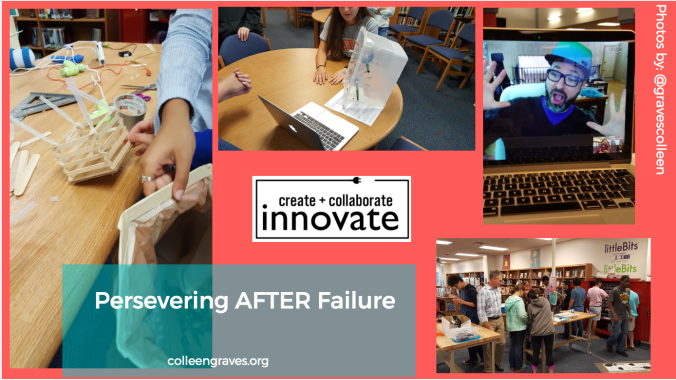
These two guys tried to make me cry a lot with the videos they showed, but they just did a phenomenal job of talking about the importance of being an educator and putting children first.  Plus, they hit on one of the themes I’m noticing pop-up over and over in sessions, conferences, and education panels. We do not want to encourage our students to fail, but rather, we have to teach them that the key to success is persisting through failure. When you fall, get up and try again!

ISTE 2017?

ISTE is in my home state next year! San Antonio! I hope you’ll come, you’ll present, you’ll learn from other awesome educators, and most importantly, you’ll say “howdy” and make some awesome life-long connections.
#CapMakerFaire and #NationofMakers Wrap Up – The Future of Making

Last month, I had the distinguished honor of being invited to speak in DC before the Capitol Hill Maker Faire as part of the week long celebration of making.

Congressman Takano opened the daytime panels by discussing why he helped co-found the Congressional Maker Caucus. What was interesting to me, were some of the constants I’ve observed from working with new makers and working with companies like Makey Makey and littleBits. Here are some of my favorite sound bites from Congressman Takano:

  • “New technology scares the general public.”
  • “It is not simple to label, but it is easy to recognize the energy of this movement.” (In regards to the maker movement)
  • “Are we ready to take making to the next level?” (and how?)
  • “Each of us can be CREATIVE and INNOVATIVE regardless of age.”

Throughout the day, listening to experts from the maker movement on these amazing panels organized by the IMLS, I heard 3 big concepts reiterated across the varied fields. (See the full line up of panel speakers here.)

  • Inclusivity (The maker movement is for EVERYONE)
  • Accessibility and democratization of tools needs to happen
  • Community based = Maker Success
  • Open Access and sharing are key

Community-Based

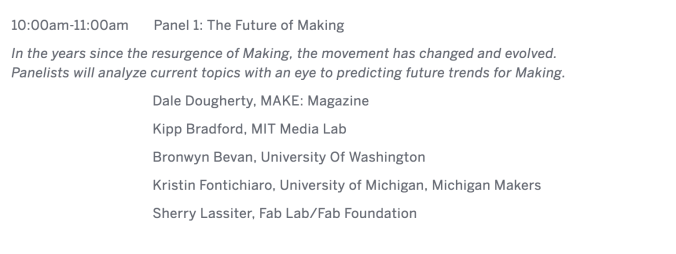
When founder of Make Magazine Dale Dougherty, asked the first panel how we can expand and grow makerspaces in schools and libraries across America, this panel had a powerhouse of answers.

Screen Shot 2016-07-05 at 7.26.45 PM.png

Sherry Lassiter stressed the importance of communicating, collaborating, and cooperating to build universal access for makers.

Capitol Hill 1_colleengraves

“Making is not about tools, but PEOPLE and the EMPOWERMENT that comes from making something with your own hands.” Sherry Lassiter

She also stressed the importance of letting students be the maker mentors for other students. (Something I’ve seen among my own students at both school makerspaces I’ve started. Letting students LEAD the learning let’s students OWN the learning.)

Kristin Fontichiaro, clinical assistant professor and faculty founder of the Michigan Makers project for elementary and middle school makers in under-resourced schools brought up many important points I’ve been focused on as of late.

  • Our “low income students are filled with high creativity”
  • “Rural communities have very different budgets and access.  They are diverse, rural, and underserved.”
  • “Some rural communities have no cell, data or Internet access.”

Bronwyn Bevan, currently Senior Research Scientist at University Of Washington (previously Director at S.F. Exploratorium) discussed the benefits of learning through making. 

  • “It encourages entrepreneurship.”
  • “Engineering is collaborative.”
  • “Hands-on STEM is the next generation of K-12.”
  • “Science is the process of learning about the world.”
  • “Tinkering is open ended and has no blueprint.”
  • “Self directed learning helps students LEVEL UP.”
  • “Educators need to create a culture of “What if?”
  • “Students need to feel empowered and supported to ask questions.”

Kipp Bradford, a research scientist at MIT Media Lab, discussed how one of the most essential aspects in the success of the future of making is that, “we need to connect our makerspaces with communities and make tools accessible.”

He also stressed that “engineering is about making the world better for humans. It is important that in all the push for STEM, we don’t lose humanity.”

The next panel continued to stress accessibility and community-driven makerspaces. Greg Mickells of Madison Public Library said something I’ve been trying to communicate everytime I’m asked to speak. “Making is not about the stuff, we should focus on people.” At the Bubbler at MPL the goal in making is “to learn, share, and create.” Patrons are encouraged to “design like MAD” in this “dynamic library environment.”

Accessibility

So how can we increase accessibility to maker education? Should we put a makerspace in every school library and public library? Could you imagine how awesome that would be?

Lisa Brahms of Make Shop Pittsburg part of the Children’s Museum of Pittsburgh proclaimed, “the point of a library is to point people towards resources.” So doesn’t that mean that a library is a natural fit for a makerspace?

I loved how Kipp Bradford went ahead and stated the obvious, “Why don’t we just make the investment to fund innovation?” What is holding us back?

Screen Shot 2016-07-06 at 10.05.44 AM

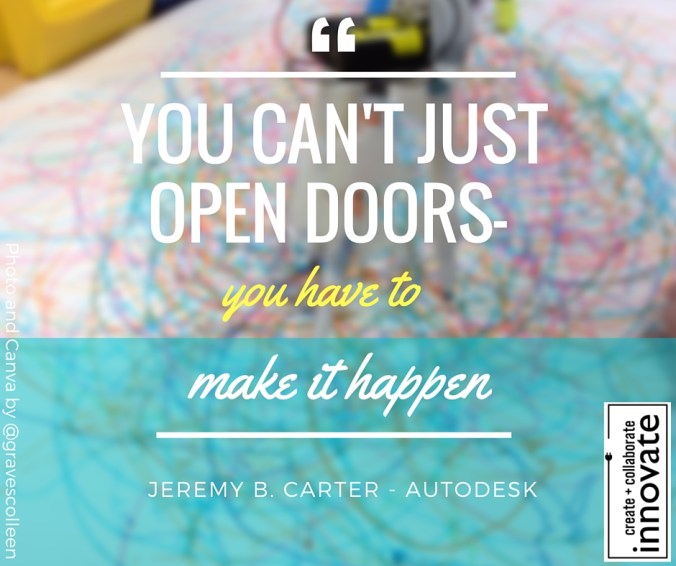
It is pertinent however, that all schools, libraries, and public officials realize that it isn’t as easy as just creating a space and letting people in. As design education evangelist  Jeremy B. Carter from Autodesk states, “You can’t just open doors, you have to MAKE it happen.”

Building a culture of creativity and making takes work. You need a facilitator (or librarian ) to help grow your makerspace. You cannot expect a successful space if you do not have a passionate maker leader driving your maker bus.

Training for teachers and staff should focus on equitable and culturally responsive makerspaces. When instituting a new makerspace, administration and teachers should discuss building a culture of making and inquiry that builds a maker community in their school. Getting students involved in the process will also drive your makerspace success and allow students to become leaders and experts in the space from the get go.

Capitol Hill 3_colleengraves

Education Panel

I had a blast sharing my own passion for making in education with the all star panel organized by the IMLS:

Screen Shot 2016-07-05 at 7.26.37 PM

Once again, our panel brought up the need for involving the community – and not just the local community, but expanding to the global maker community. We also stressed the importance of process over product, failing forward (or as Congressman Takano put it, working from the “failures you learn from and successes you build on.”

Don’t be afraid to learn alongside your students. Even if it means exposing yourself to failing in front of them. This is a good thing. Kids need to see us fail and move on.

Throughout the course of the day, I heard a lot about marketing, manufacturing, and entrepreneurship, and while I appreciate that the maker movement facilitates these things….  it is not why I believe that making in education is relevant and indispensible.

You see, I used to have an Etsy shop and make things for others, but what I love about the maker movement is not making things for others.

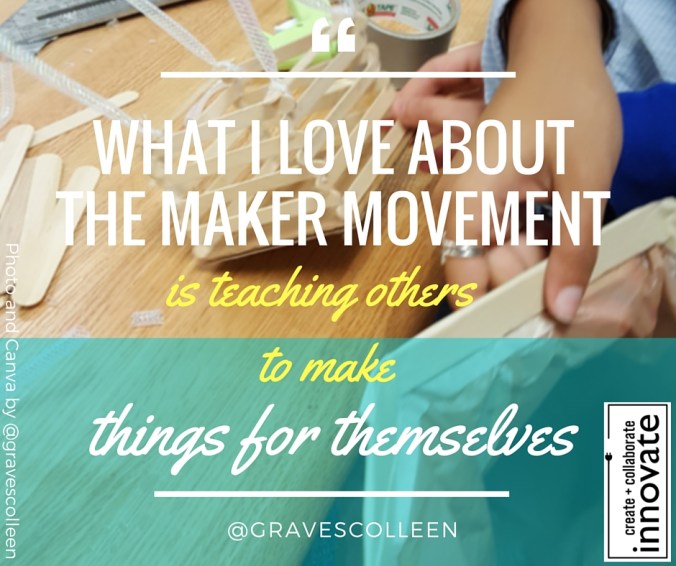
What I love is teaching others to make things for themselves. That’s why I enjoy being an educator even more than being an artist or a maker. I think a lot of this stems from my love for the transcendentalist movement founded on the ideas by Thoreau and Emerson who believed that humans should think for themselves AND be self sufficient.Capitol Hill 4_colleengraves

While I would love for my students to grow up and invent the next big thing, thinking that all of these kids caught up in the maker movement will grow up to be the next Elon Musk is a bit far fetched. That is like assuming all students who take math will grow up to be mathematicians.

Instead, we should focus on the fact that these engaging activities are essential skills for all of our students to gain!  Making teaches students to work collaboratively in ways that our curriculum often doesn’t. Many times, our students leave our schools lacking the ability to problem solve, work in a group, act as a leader, and deal with failure because it isn’t in the curriculum.  

The good news is that these are all skills students can build through making.

Evening Maker Faire

In the evening, Aaron and I taught Maker Faire attendees how to make their own simple paper circuit and even how to make a simple DIY switch. One of the highlights for me was teaching fellow Dentonite and Congressional Science Fellow David Visi how to make a paper circuit. Another highlight was watching Aaron teach a gaggle of Girls Scouts about circuitry. Thanks so much to Chibitronics for providing some circuit stickers and if you are interested in our templates they are in our upcoming book – The Big Book of Makerspace Projects to be published in October 2016.

Thank you again to the IMLS for organizing such a great day! It was a blast and wonderful experience and I hope I am able to attend the next one!