I was honored this last month to be a part of the review panel for the CTE Makeover Challenge before submissions headed on over to the final judges. If you haven’t heard of this amazing opportunity, be sure to head on over to CTE Makeover Challenge to read more about the details. I’m hoping the US Dept. of Education will offer this challenge again next year.
I can’t wait to hear which schools will receive the final awards! It should be announced next week during the National Week of Making!
Making and Education- Capitol Hill Maker Faire Panels
I’m also excited and honored to announce that I’ve been invited to speak on a panel for the Congressional Maker Caucus before the Capitol Hill Maker Faire in DC on June 21st. (Hosted by the Institute of Museum and Library Services). Registration is free and open to the public! If you are in the DC area, just register through this link to attend! This very distinguished panel will be answering questions regarding “Making and Education K-12.” I’m overjoyed at this opportunity to share my passion for school library makerspaces alongside this panel of experts.
Capitol Hill Maker Faire
Aaron and I will also be featured makers at the evening Capitol Hill Maker Faire where we will be sharing paper circuit activities from our upcoming book the Big Book of Makerspace Projects. We believe everyone is a maker, so we think you’ll enjoy making these beginner maker activities with us!
Here is more info on the evening faire as provided by IMLS:
“The Capitol Hill Maker Faire will be held on June 21, during the Week of Making in the Nation’s Capital. It will be a fun and interactive event for members of the public, including members of Congress and their staff. The National Maker Faire will be held on June 18-19.
Hosted by the Institute of Museum and Library Services in collaboration with the Congressional Maker Caucus, the event explores the movement driven by hobbyists, tinkerers, crafters, and innovators that is changing the face of informal learning at community institutions and is breathing new life and innovation into American manufacturing.”
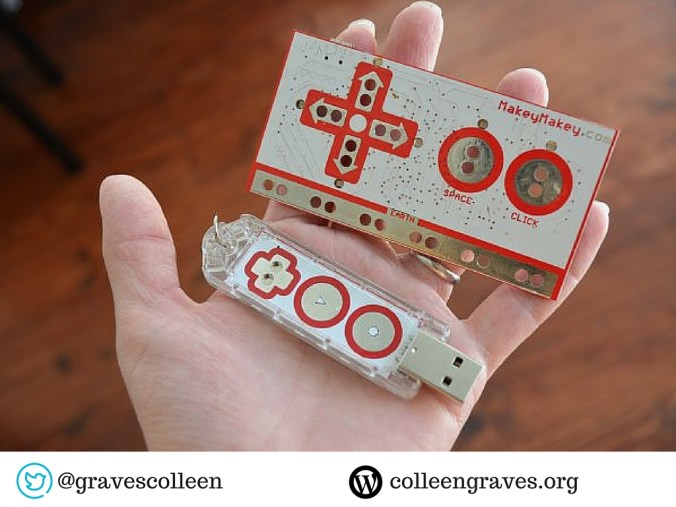
This is the first in a series of posts describing the Invention Literacy Research Project that I worked on collaboratively with one of my English Teachers- April Feranda. About 6 months ago, I watched this video by Jay Silver defining the term. I immediately loved this concept because it perfectly describes what I’ve been attempting to do in my library makerspace since May of 2013. After writing lessons for Makey Makey last year, I realized I went through the ultimate training on Invention Literacy. I wanted to share that journey with you to help you become invention literate as an educator. April Feranda and I would love for your students to become invention literate. Therefore, we are putting this out there for you to hack and personalize and make your own.
My Journey with Makey Makey and Becoming Invention Literate
When I wrote the lesson plans for Makey Makey, I really had to push my thinking about how I could take this invention kit and really make it educational. I’d seen enough lessons driven by technology and not by educational concepts and did not want my lessons to feel forced or feel like technology for technology’s sake. I wanted the educational necessity to drive the lessons and not the other way around.
My first step in creating lessons was to do a little crowdsourcing for research. I had to look at the ways other people were using Makey Makey as a way to get myself beyond the banana.
But I think the reason I really like the term “invention literacy” is because after spending last summer pushing myself to create, make, and dream up projects with Makey Makey and make all those things- well it changed me.
Now, I feel that I really can “change the world we live in.” Chatting with the Makey Makey team during the #MakeyMakeyChallenge in 2015 indirectly led to me writing those lessons, and those lessons led to me getting asked to write a book! And now Aaron and I have 3 book contracts?! (One behind us, one in front of us, and one in the near future!) So really, once I got myself beyond making banana pianos, I quickly became emboldened with creative confidence. (A warning that already exists on the Makey Makey packaging… they may need to make that warning BIGGER!)
I want to give that same feeling to my students. I want them to believe that they can have an idea and find a way to make it come to life….as Jay puts it,”to change the world we live in.”
Now when I look at stuff, I think about dissecting it and figuring out how I can make my own version of that thing with a Makey Makey. If I see an interactive display, I think, “I bet I could make that with a Makey Makey.”
Favorite Maker Tools
Another reason I love the Invention Literacy Movement is that it directly relates to making our kids active producers of our world and not passive consumers. I’m tired of seeing apathetic kids that look like digital zombies. I want to see kids that are curious and that want to know how stuff works because they want to make the world a better place. It’s one of my main goals in my library makerspace and I love to see these ideas take hold of my students and see the change it enacts upon them!
I am also hoping that the Makerspace project book Aaron and I just finished can help other educators and students become “Invention Literate.” Our whole book is filled with projects designed to teach kids how stuff works and our main goal in writing this book was to help kids/adults/humans realize they can make their own version of many different types of things!
So rather than reserve all of this Invention Literacy goodness for a book, I think getting this idea out there is helpful because it will get others to realize that the idea behind Invention Literacy is something valid and important for all of us. Like Jay said in this Ted Talk, “We should all be curious about the way the world works. And we should all create our world.”
Introducing Invention Literacy to Students
Luckily for me, April Feranda wanted to engage her students in something new for research at the end of this school year. I told her I had a crazy idea…. I wanted to focus our research project on Invention Literacy and the driving question:
“How does ______ work and can I make my own version of it?”
She thought it sounded interesting and we spent a few hours planning some initial challenges to acquaint all of her students with the resources in our library makerspace, but also to get our students to begin thinking like an inventor by making things with their hands and not having a teacher hold their hand through the process.
Creating maker journals: Inside those we had students define inventions, prototype, and technology all in their own words (next year we want to add literacy to their definition explorations!) Then students wrote their own definitions on larger paper and questioned each others definitions of terms.
Every student took the time to really look and interact with an article from Jay Silver by doing a write-around text activity inspired from Buffy Hamilton. Jay called it Medium IRL (In Real Life.) We broke the article up and had students quietly reflect on paper and react to the article as they read it. You can see the full post and the students reflection discussing the article here.



 Petite Texan: Pack, Pedal, Paddle