 Session Info
In our interactive session for “Makerspace in the Library: What it means for your Classroom,” we really let our participants drive the learning.
We started out with an introduction for each expert presenter (here is our slidedeck with presenter info and resources we referred to during the session.) Then the rest of the learning was hashed out through lively table discussions.
Other Workshop Leaders:
- Buffy Hamilton, Title I Writing teacher, former librarian; Atlanta, GA
- Zach Duensing, Nashville Public Library
- Valerie Jopeck, Elementary Library Education Specialist, Fairfax County Public Schools, VA
- K-Fai Steele, Program Associate, National Writing Project
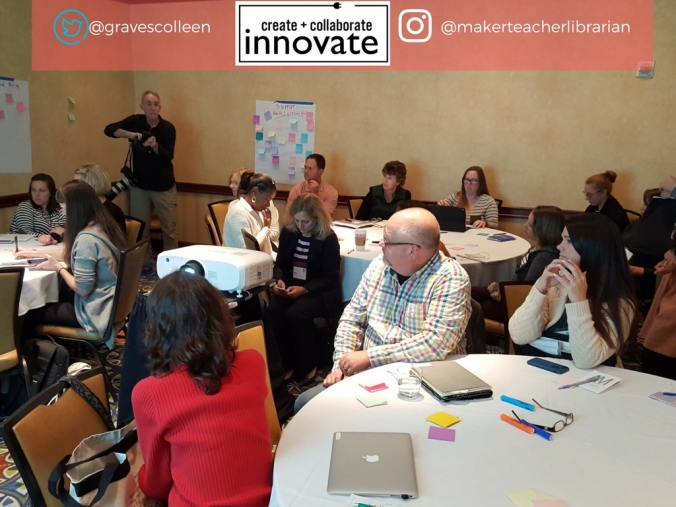
We asked our participants some simple questions to help divide our learning up into different themes. (Thanks for these guiding questions, K-fai!)
- Why are you interested in makerspaces?
- What questions do you have?
- How have you connected (or not) with them?
Our writers wrote ideas on Post-its and then we divided these post-its into overarching themes.
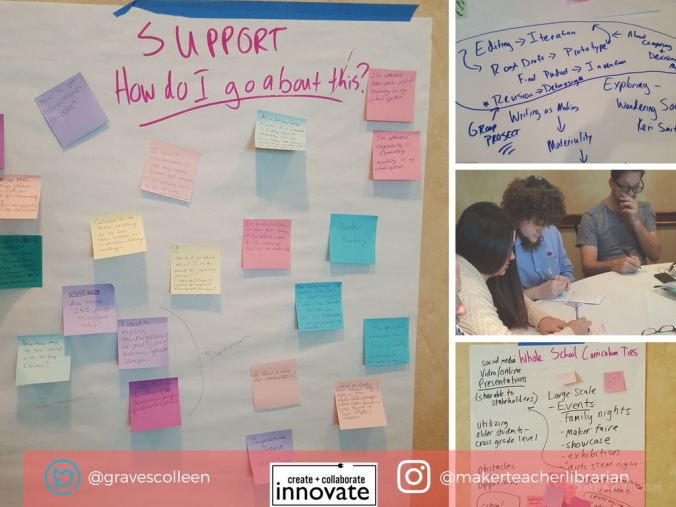
Emerging Themes
It quickly became evident that our communal thinking could be divided up as:
- Support: How do I go about starting this?
- Whole School Curriculum Ties
- Community
- Writing and Making (and how it could tie to research and inquiry)
Each presenter took a table and we dug deeper into the conversation.
Community and Whole School Curriculum Ties
Valerie and Buffy’s table really thought about creating school and district cultures that led to making. They discussed “student generated content that educators could share with stakeholders via social media and online platforms.” They also stressed the importance of leveraging community and creating inclusive spaces. One of my favorite suggestions was the idea of holding different types of “Large Scale Events” like:
- Family Nights
- Maker Faire
- Showcase
- Exhibition
- “Girls Stem Nights”
Writing and Making
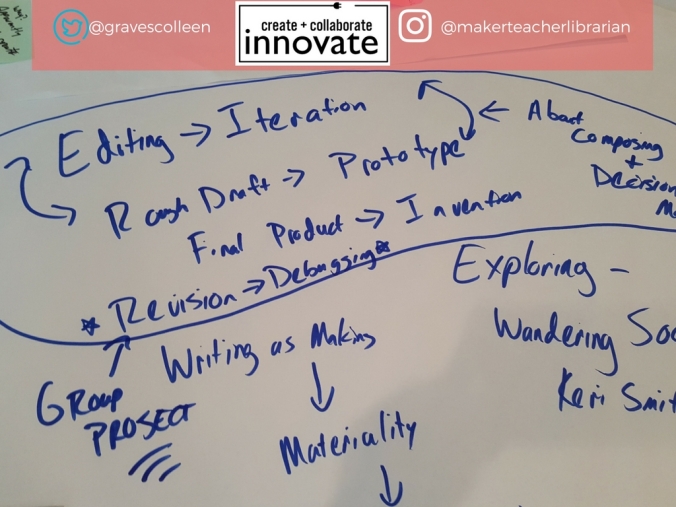
My table discussed how we can embrace making as writing teachers. One of the biggest a-has at our table was a great idea sparked by Valerie’s statement during her intro, “What you call editing, we call iteration.” My table quickly got to work discussing how many steps in the making process parallel with the writing process.
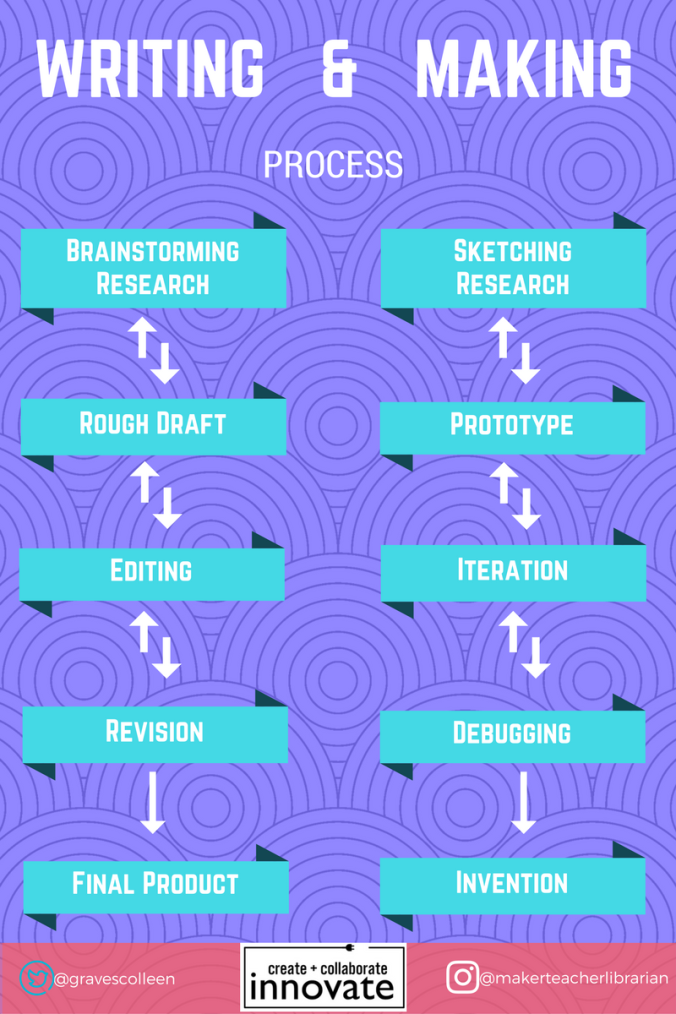
- Brainstorming>Sketching/Research
- Rough Draft> Prototype
- Editing> Iteration
- Revision> Debugging
- Final Product >Invention
What I loved about this conversation was the idea that many of us stay in this constant conversation of creating rough drafts and making revisions when writing. Just as many maker projects stay heavily embedded in research and iterations. Many times in both forms, not all of projects end up as final drafts (i.e. inventions!) But as one of my table members said, “Just the idea that writing is making lends to teaching the materiality of writing and focuses on collaboration in such a multi-model context. This allows students to reflect, grow, persevere, and re-vision their work.”
We also discussed the importance of revision and debugging as a group project. That many times in the “real world” this revision is done in a collaborative nature. We bring our busted prototypes out to others and ask, “How can we make this better?”
What makes this conversation even more important, is that lately many of us in the maker movement have been stressing the importance of process over product. The real learning happens during the process of making, not looking at a final invention. Sometimes, our student’s final invention is just a cardboard tube with a strawberry container on top. It looks like trash, but to the eye of the inventor, it’s a magnificent bird feeder. (Thanks to my own kid for this anecdote!) The real meaning students get from making is in the process. Not the product. A 3D printed object isn’t the learning, the student designing a 3D model in software is where the real learning takes place. Although, after printing their first iteration, they might realize they need to revise their design (i.e. debug) so that their 3D printed object comes out as one piece, can stand up, or whatever flaw they realize after printing a prototype. The 3D printed object helps them see how to revise their design before printing another iteration. As my table mates pointed out, this stage of drafting (prototyping) and editing (creating iterations) is about composing and decision making.
Reflection as Process
Another huge aha for my table was the idea that writing a reflection about the writing process is difficult. However, when students write a reflection after making, reflecting is easier because of the deep thinking that occurs during the process of making. One table member said, “Could we use this idea of reflective writing after making to help give our students the taxonomy for reflecting on their writing process? Will there be a transference of learning?” During our share out, another participant noted that “reflection is based on awareness and when students are making with their hands they are hyper aware of their actions (vs when they are writing.)”
Collectively we decided that “reflective writing post making is much richer and that we could use maker journals as a place to help capture this learning.”
Making as Procedural Writing
Another favorite aha moment was when someone said, “No one sat down and wrote a cookbook, they cooked a lot first!” So if we decide as teachers to incorporate procedural writing with our makers, we have to let them make a lot BEFORE we ask them to attempt writing out their steps for procedural writing.
More Big Ideas from Learners
Power of Play: “Making gives us the ability to reseat the role of writing outside of our normal writing assignments. It allows us to take apart writing.”
Engagement: “(It) Provides interest-driven learning experiences for students” and “Students construct knowledge and really take ownership of new learning.”
Change: “Making represents a shift from formalism to constructivism. One of the few recent trends in education that does so.” and “A makerspace breaks out of traditional education.”
Interdisciplinary: “Making is a vehicle to facilitate interdisciplinary collaboration between teachers and learning for students.”
Real World: “We want to link our makerspace / innovation space to Problem Based Learning to respond to community and real world concerns through STEAM partnerships.”
Final Takeaways
I was honored to be invited and to be among such an all star panel of librarians! It was such a great session and I loved being surrounded by teachers who see the connection between making and literacy. Plus, I adored discovering together how the processes of making and writing mirror each other and discussing how the conversation between making and writing can help our students grow in both areas. I also realized I need to make time to come to the National Writing Project Meeting EVERY YEAR! What a great group of educators!
How about you? How do you see the connection between making and writing?


 Petite Texan: Pack, Pedal, Paddle