Maker Book Review: Invent to Learn Guide to Fun

Guidetofunreview1

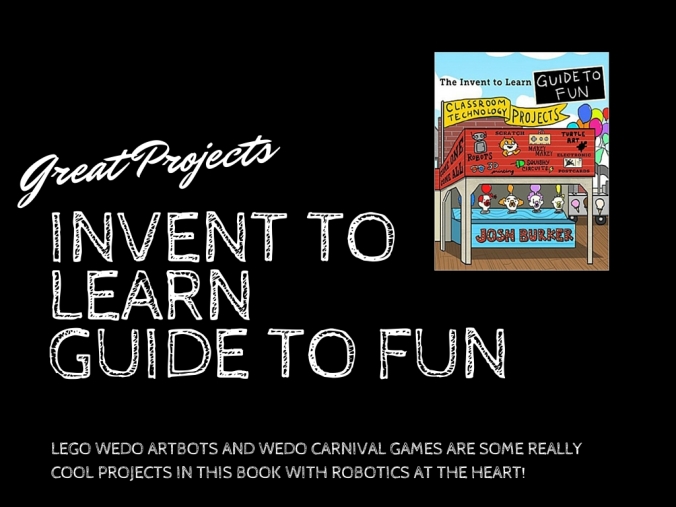
If you’ve visited my Makerspace Resources page, you’ll already know that I suggest this The Invent to Learn Guide to Fun as one of the must have Maker books to get you started in your maker education journey. However, I’ve found myself with TWO copies of this fabulous book, so I wanted to share why I love this book, and …. well, you’ll have to read the whole post for all the details.

Quick Summary

This is a whimsical and fun project book for makers of any age! With a focus on robotics, 3D printing, Scratch, and Makey Makey, you’ll find high-low tech projects for every makerspace.

Best Age Group – ALL

Since the majority of projects focus on LEGO, Makey Makey, and drag and drop programming, you might be tempted to only buy this as an elementary educator. However, I think the projects in this book are fun for makers age 6 – 106. High school students still love making artbots, paper circuits, and sewing circuits and Burker has included easy hands-on projects in this book from Constructing Modern Knowledge Press.

Usability and Feasibility

If you’ve attempted any Instructables projects lately, you might be wondering just how feasible it is to follow the projects in this book.  Burker does a GREAT job writing out the steps for each project and includes just the right amount of pictures to get you through if you are a visual learner. My 7 year old and I attempted and completed many of the LEGO projects in this book. I learned how to use TurtleArt and convert 2D files into 3D design files for 3D printing. The projects are fun and doable for makers of any caliber. The wording is flexible enough that young makers could follow projects without the assistance of an adult, but is also challenging enough that adults can have fun making these projects too!

Plus, I really love the write-ups for the Makey Makey Musical Instrument Project and the Makey Makey Operation Game.

Flexibility and Longevity

If projects are easily hacked, then you know you’ve found a great project book! As Burker says in his “Where Do Good Projects Come From?” chapter, “Every project can be extended.” As a student of constructivist Gary Stager, Burker wrote every project in this book with the intent that each maker would personalize, hack and take each project further. Once you and your students start making projects from this book, you’ll find yourself thinking, “And then??”

Guidetofunreview2

For example, after seeing a Spin Art Machine that Josh made based on the LEGO Wedo Carousel project from this book, my 7 YO and I started our own journey into #LEGOtinkering. (LEGOtinkering was introduced to me by The Tinkering Studio as they were experimenting with Lego linkages while my Ryan Library students were starting their Invention Literacy Project mentioned in a recent post.) At first we attempted Burker’s version, but couldn’t pour our paint without making a mess, so my 7 YO just used it to maker perfect circle art (Because I was already trying to hack it unsuccessfully! )

Then we started trying to control our Spin Art with Scratch on my 7 YO’s Kano Computer.

However, we got paint all over our living room ( don’t worry, we cleaned it up- but remember MAKING IS MESSY.) I let the idea settle for awhile and started playing with LEGOs on a daily basis so I could become more versed in tinkering with LEGOs and inventing contraptions. I bought more gears and LEGO Technic bricks and am now blaming Josh Burker, Ryan Jenkins from The Tinkering Studio, Amos Blanton, and Peter Hoh for making me an adult LEGO addict. (I even learned to use a laser cutter so I could make my students some LEGOtinkering boards!)

These books are decent springboards, but the instructions aren’t super clear….

Just this weekend, the #superlibrarianhubs saw a hand cranked Beaker Blender I made from the Crazy Contraption book above and suggested I merge that idea with Burker’s Spin Art Machine and that turned into this super silly hand cranked LEGO Spin Art Machine.

This eventually merged back into a motorized spin art machine like in Josh’s post.

But as Josh mentions in his book, “By documenting your project and sharing it with others you invite people to change, expand, modify, and grow your work.”

One of the best thing about maker projects is that you can continually change, adapt, and rework projects and look at them with fresh eyes.

Giveaway

So now it is your turn! Since I am in possession of a second copy ofThe Invent to Learn Guide to Fun , I’m going to give away my second copy! All you have to do is comment on this blog post with your name and your school (or library.) I’ll randomly choose a winner, and I’ll mail you this book!

Entry to this giveaway ended June 15th at 9pm.

Happy making! I’d love to see what you make and remix based of Burker’s book!

Wilson County Public Libraries won! Congrats, guys! Ping me your address!

wp-1466084894659.jpg


Invention Literacy Research – Part One

InventionLiteracy Colleengraves.org.png

This is the first in a series of posts describing the Invention Literacy Research Project that I worked on collaboratively with one of my English Teachers- April Feranda. About 6 months ago, I watched this video by Jay Silver defining the term. I immediately loved this concept because it perfectly describes what I’ve been attempting to do in my library makerspace since May of 2013.  After writing lessons for Makey Makey last year, I realized I went through the ultimate training on Invention Literacy. I wanted to share that journey with you to help you become invention literate as an educator. April Feranda and I would love for your students to become invention literate. Therefore, we are putting this out there for you to hack and personalize and make your own. 

My Journey with Makey Makey and Becoming Invention Literate

When I wrote the lesson plans for Makey Makey, I really had to push my thinking about how I could take this invention kit and really make it educational. I’d seen enough lessons driven by technology and not by educational concepts and did not want my lessons to feel forced or feel like technology for technology’s sake. I wanted the educational necessity to drive the lessons and not the other way around.

My first step in creating lessons was to do a little crowdsourcing for research. I had to look at the ways other people were using Makey Makey as a way to get myself beyond the banana.

But I think the reason I really like the term “invention literacy” is because after spending last summer pushing myself to create, make, and dream up projects with Makey Makey and make all those things- well it changed me.

Now, I feel that I really can “change the world we live in.” Chatting with the Makey Makey team during the #MakeyMakeyChallenge in 2015 indirectly led to me writing those lessons, and those lessons led to me getting asked to write a book! And now Aaron and I have 3 book contracts?! (One behind us, one in front of us, and one in the near future!) So really, once I got myself beyond making banana pianos, I quickly became emboldened with creative confidence. (A warning  that already exists on the Makey Makey packaging… they may need to make that warning BIGGER!)

I  want to give that same feeling to my students. I want them to believe that they can have an idea and find a way to make it come to life….as Jay puts it,”to change the world we live in.”

Now when I look at stuff, I think about dissecting it and figuring out how I can make my own version of that thing with a Makey Makey. If I see an interactive display, I think,  “I bet I could make that with a Makey Makey.”

MakeyMakeyGo

Favorite Maker Tools

Another reason I love the Invention Literacy Movement is that it directly relates to making our kids active producers of our world and not passive consumers. I’m tired of seeing apathetic kids that look like digital zombies. I want to see kids that are curious and that want to know how stuff works because they want to make the world a better place. It’s one of my main goals in my library makerspace and I love to see these ideas take hold of my students and see the change it enacts upon them!

I am also hoping that the Makerspace project book Aaron and I just finished can help other educators and students become “Invention Literate.” Our whole book is filled with projects designed to teach kids how stuff works and our main goal in writing this book was to help kids/adults/humans realize they can make their own version of many different types of things!

So rather than reserve all of this Invention Literacy goodness for a book, I think getting this idea out there is helpful because it will get others to realize that the idea behind Invention Literacy is something valid and important for all of us. Like Jay said in this Ted Talk, “We should all be curious about the way the world works. And we should all create our world.”

Introducing Invention Literacy to Students

Luckily for me, April Feranda wanted to engage her students in something new for research at the end of this school year. I told her I had a crazy idea…. I wanted to focus our research project on Invention Literacy and the driving question:

“How does ______  work and can I make my own version of it?”

She thought it sounded interesting and we spent a few hours planning some initial challenges to acquaint all of her students with the resources in our library makerspace, but also to get our students to begin thinking like an inventor by making things with their hands and not having a teacher hold their hand through the process.

We started by meeting with all of the students as one big group and showing them Jay’s TED talk to help them think differently about the way they see everyday objects. We wanted them to see the world as their toolkit. April and I showed them many inventions from The Big Book of Makerspace Projects and we shared some #LEGOTinkering videos from the Tinkering Studio (Part of The Exploratorium Museum in San Francisco and also the epic brain power behind Art of Tinkering!)

Then we broke students up into stations:

Day 1

  • Creating maker journals: Inside those we had students define inventions, prototype, and technology all in their own words (next year we want to add literacy to their definition explorations!) Then students wrote their own definitions on larger paper and questioned each others definitions of terms.
  • littleBits Challenges
  • Makey Makey Poetry

Day 2

  • Students delved into defining and articulating invention literacy. What is it? And why does it matter? (See below)
  • littleBits Challenges (Part 2)
  • Makey Makey Poetry (Part 2)

Articulating Invention Literacy

Every student took the time to really look and interact with an article from Jay Silver by doing a write-around text activity inspired from Buffy Hamilton. Jay called it Medium IRL (In Real Life.) We broke the article up and had students quietly reflect on paper and react to the article as they read it. You can see the full post and the students  reflection discussing the article here

This slideshow requires JavaScript.

More Resources

Watch this super short video: