What a Makerspace can mean for the Writing Classroom -Takeaways from NWP Annual Meeting

colleengravesposts (8).pngSession Info

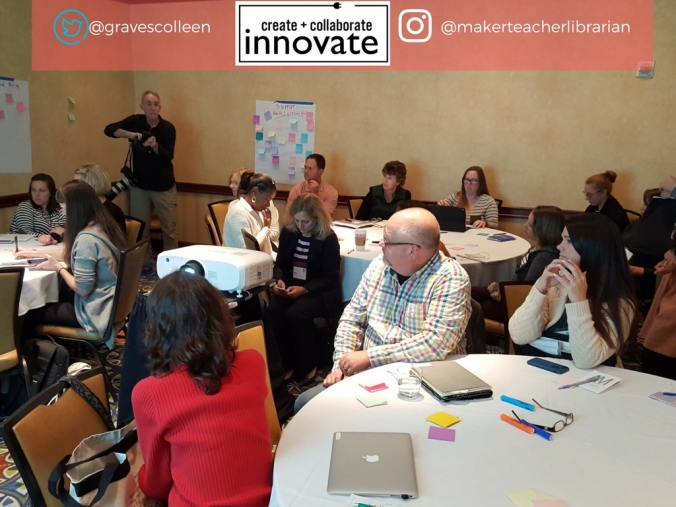
In our interactive session for “Makerspace in the Library: What it means for your Classroom,” we really let our participants drive the learning.

We started out with an introduction for each expert presenter (here is our slidedeck with presenter info and resources we referred to during the session.) Then the rest of the learning was hashed out through lively table discussions.

Other Workshop Leaders:

  • Buffy Hamilton, Title I Writing teacher, former librarian; Atlanta, GA
  • Zach Duensing, Nashville Public Library
  • Valerie Jopeck, Elementary Library Education Specialist, Fairfax County Public Schools, VA
  • K-Fai Steele, Program Associate, National Writing Project
 

colleengraves-org1

We asked our participants some simple questions to help divide our learning up into different themes.  (Thanks for these guiding questions, K-fai!)

  • Why are you interested in makerspaces?
  • What questions do you have?
  • How have you connected (or not) with them?

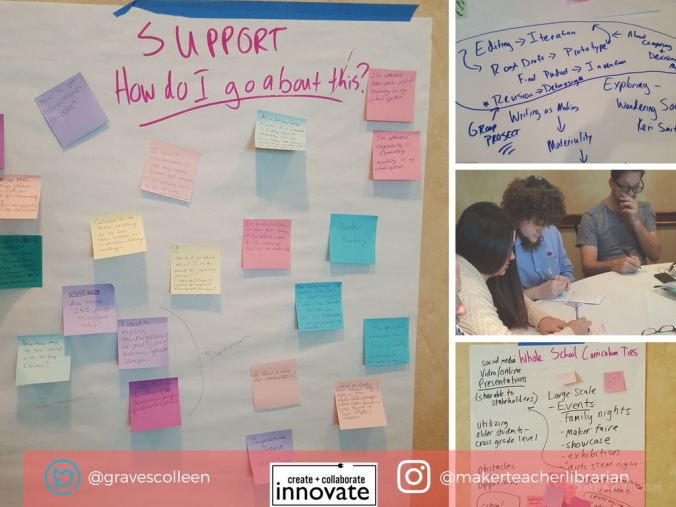
Our writers wrote ideas on Post-its and then we divided these post-its into overarching themes.
colleengraves-org2

Emerging Themes

It quickly became evident that our communal thinking could be divided up as:

  • Support: How do I go about starting this?
  • Whole School Curriculum Ties
  • Community
  • Writing and Making (and how it could tie to research and inquiry)

Each presenter took a table and we dug deeper into the conversation.

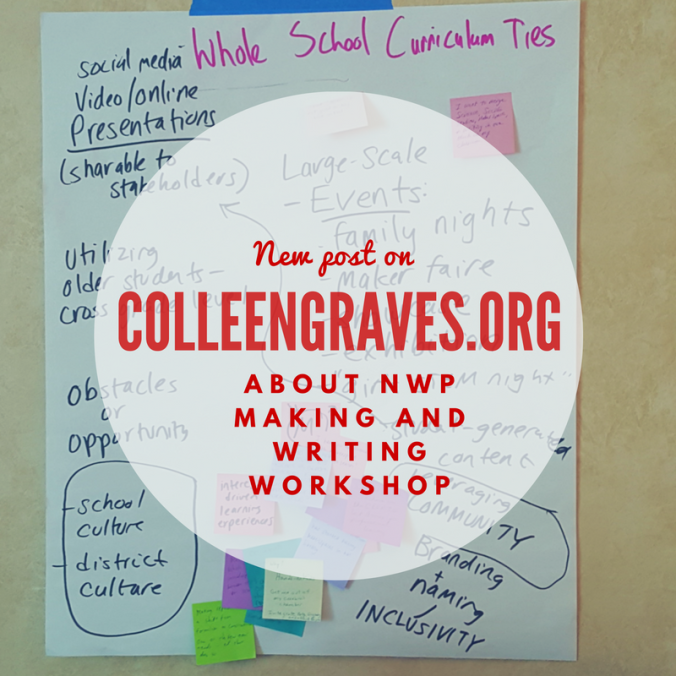
Community and Whole School Curriculum Ties

Valerie and Buffy’s table really thought about creating school and district cultures that led to making. They discussed “student generated content that educators could share with stakeholders via social media and online platforms.” They also stressed the importance of leveraging community and creating inclusive spaces.  One of my favorite suggestions was the idea of holding different types of “Large Scale Events” like:

  • Family Nights
  • Maker Faire
  • Showcase
  • Exhibition
  • “Girls Stem Nights”

Writing and Making

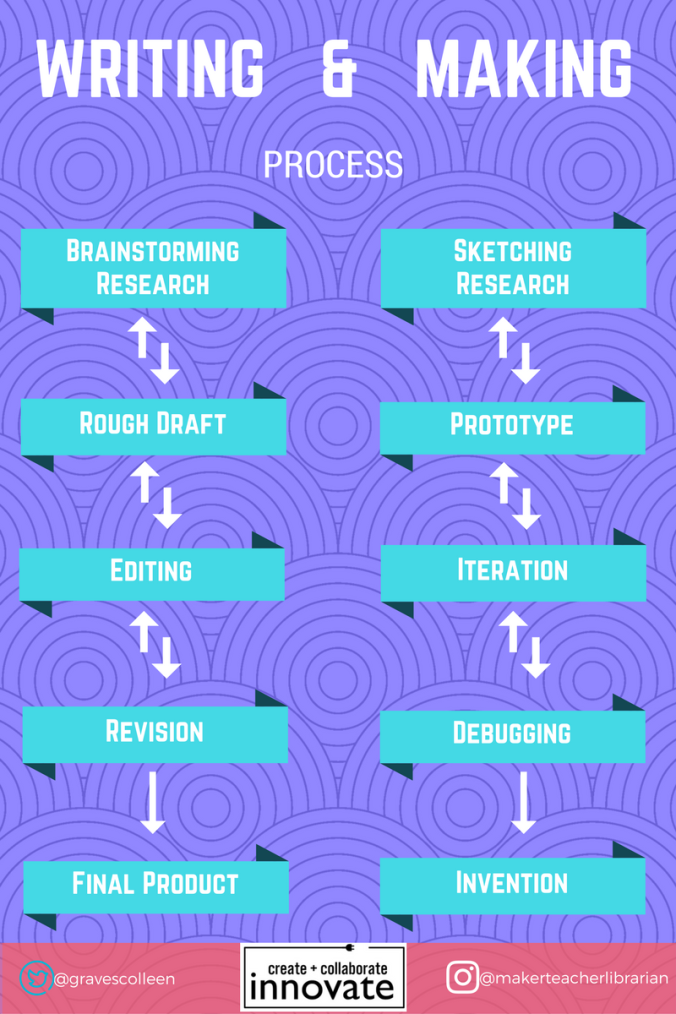
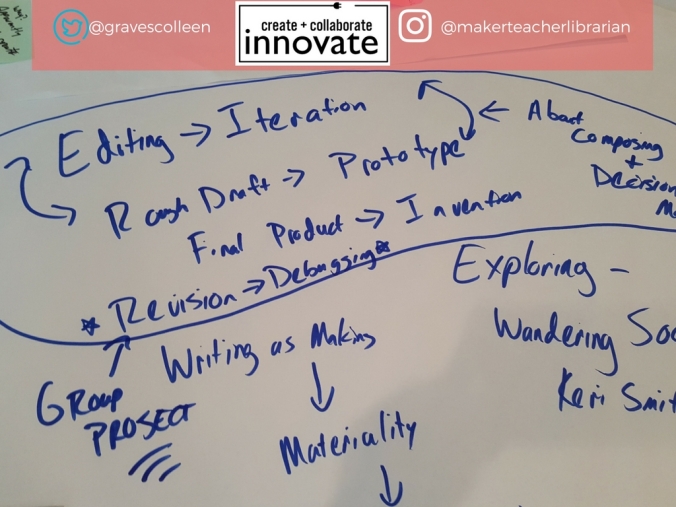
My table discussed how we can embrace making as writing teachers. One of the biggest a-has at our table was a great idea sparked by Valerie’s statement during her intro, “What you call editing, we call iteration.” My table quickly got to work discussing how many steps in the making process parallel with the writing process.
writing-and-making-colleen-graves-org

  • Brainstorming>Sketching/Research
  • Rough Draft> Prototype
  • Editing> Iteration
  • Revision> Debugging
  • Final Product >Invention

What I loved about this conversation was the idea that many of us stay in this constant conversation of creating rough drafts and making revisions when writing. Just as many maker projects stay heavily embedded in research and iterations.  Many times in both forms, not all of projects end up as final drafts (i.e. inventions!) But as one of my table members said, “Just the idea that writing is making lends to teaching the materiality of writing and focuses on collaboration in such a multi-model context.  This allows students to reflect, grow, persevere, and re-vision their work.”

We also discussed the importance of revision and debugging as a group project. That many times in the “real world” this revision is done in a collaborative nature.  We bring our busted prototypes out to others and ask, “How can we make this better?”

What makes this conversation even more important, is that lately many of us in the maker movement have been stressing the importance of process over product. The real learning happens during the process of making, not looking at a final invention. Sometimes, our student’s final invention is just a cardboard tube with a strawberry container on top. It looks like trash, but to the eye of the inventor, it’s a magnificent bird feeder. (Thanks to my own kid for this anecdote!) The real meaning students get from making is in the process. Not the product.  A 3D printed object isn’t the learning, the student designing a 3D model in software is where the real learning takes place. Although, after printing their first iteration, they might realize they need to revise their design (i.e. debug) so that their 3D printed object comes out as one piece, can stand up, or whatever flaw they realize after printing a prototype. The 3D printed object helps them see how to revise their design before printing another iteration.  As my table mates pointed out, this stage of drafting (prototyping) and editing (creating iterations) is about composing and decision making.
colleengraves-org3

Reflection as Process

Another huge aha for my table was the idea that writing a reflection about the writing process is difficult. However, when students write a reflection after making, reflecting is easier because of the deep thinking that occurs during the process of making. One table member said, “Could we use this idea of reflective writing after making to help give our students the taxonomy for reflecting on their writing process? Will there be a transference of learning?”  During our share out, another participant noted that “reflection is based on awareness and when students are making with their hands they are hyper aware of their actions (vs when they are writing.)”

Collectively we decided that “reflective writing post making is much richer and that we could use maker journals as a place to help capture this learning.”

Making as Procedural Writing

Another favorite aha moment was when someone said, “No one sat down and wrote a cookbook, they cooked a lot first!” So if we decide as teachers to incorporate procedural writing with our makers, we have to let them make a lot BEFORE we ask them to attempt writing out their steps for procedural writing.

More Big Ideas from Learners

Power of Play: “Making gives us the ability to reseat the role of writing outside of our normal writing assignments. It allows us to take apart writing.”

Engagement: “(It) Provides interest-driven learning experiences for students” and “Students construct knowledge and really take ownership of new learning.”

Change: “Making represents a shift from formalism to constructivism. One of the few recent trends in education that does so.” and “A makerspace breaks out of traditional education.”

Interdisciplinary: “Making is a vehicle to facilitate interdisciplinary collaboration between teachers and learning for students.”

Real World: “We want to link our makerspace / innovation space to Problem Based Learning to respond to community and real world concerns through STEAM partnerships.”

Final Takeaways

I was honored to be invited and to be among such an all star panel of librarians! It was such a great session and I loved being surrounded by teachers who see the connection between making and literacy. Plus, I adored discovering together how the processes of making and writing mirror each other and discussing how the conversation between making and writing can help our students grow in both areas. I also realized I need to make time to come to the National Writing Project Meeting EVERY YEAR! What a great group of educators!

How about you? How do you see the connection between making and writing?
 

Invention Literacy Research – Part Three- Sharing and Reflection

colleengraves.png

This is the third post in a series describing the Invention Literacy Research Project that I worked on collaboratively with one of my English Teachers in the 2015-2016 school year- April Feranda. About 6 months ago, I watched this video by Jay Silver defining the term “Invention Literacy.” I immediately loved this concept because it perfectly describes what I’ve been attempting to do in my library makerspace since May of 2013.  After writing lessons for Makey Makey in 2015, I realized I went through the ultimate training on Invention Literacy and boosting creative confidence. I wanted to share that journey with you to help you become invention literate as an educator. April Feranda and I would love for you and your students to become more invention literate. Therefore, we are putting this out there for you to hack and personalize and make your own. Read post one and post two if you haven’t had a chance to read them yet.

After researching and learning from the tinkering experts at The Tinkering Studio, students spent two class periods (and plenty of time after school) finishing prototypes for our finale Maker Fest. One of the coolest things about this project was that students were picking up making skills as needed. The student in the video below needed to learn how to use our saw while creating marble runs, so I was able to teach some saw safety on the fly!

I was also pleasantly surprised when students stayed after school and we made up quicker ways to create soft circuits by utilizing conductive fabric tape from the Makey Makey Inventor Booster Kit and hardware store foil tape.

Sharing Maker Fest

On the due date, Mrs. Feranda and I decided to hold a Maker Fest and just like at a real Maker Faire, students presented their prototypes in a show and tell style fashion. If you hold your own Maker Fest, you need to make sure you:

  • Get others involved
    • Invite community
    • Invite inventors via Skype
    • Invite other Students or classrooms
  • Have students be prepared to speak about invention literacy, historical context, and the most challenging part of creating an invention
  • Make GIFs of prototypes ( with Spin turntable or another documentation) to keep a digital record of inventions.

Some of my favorite projects were made out of all recyclables (this helicopter and water turbine), while others combined favorite maker tools with recyclables to make miniature versions of everyday things! (Makey Makey piano and littleBits tank below)

Surprise Virtual Guest Jay Silver

During our Maker Fest, we had a surprise virtual guest, Jay Silver! I carried him around via my computer so he could chat with each group or individual about their #rhsmakes. He did an awesome job casually chatting with kids about what they made. Students really enjoyed sharing their creations with this awesome inventor and Jay was great about asking students about their invention process. One of my favorite things was how he asked each student questions pertinent to their own invention.

If you implement this project at your school, it is important that you and your co-teachers understand that the process and the meaning a student gets from making are one of the most important aspects to making and education. The final product can be faulty and that’s okay. One of our students during this project decided she was going to build magnetic gears. She never got a working prototype, and was a tad upset about the outcome. However, when we Skyped with Jay Silver during our Maker Fest, he was extra impressed with her idea and original concept. He spoke at length to her about her process, her thinking, and her many attempts that ended in failure. Through this conversation, she was able to see how much she learned throughout the project. During the project, Feranda and I worked on explaining this to all of our students, and explaining that persevering after failure is what leads to innovation.

This whole research project was the perfect blend of academic research and crowdsourced research.  For example, after researching how cars were made, the student below wanted to build a littleBits car. He found a crowdsourced Youtube video and tried to replicate the car from the video, only to find that there were missing steps, and parts he did not have access to. Instead, he ended up looking at gears and mechanisms, then found his own way to make and create a tank out of an old 3D filament box.

Reflection

After our Maker Fest, students went back to class to finish out the school year. Since reflection is an integral part of the process, we gave them a break and then had them create video reflections via Flipgrid. We are hoping to compile these videos and use them as a springboard for this year’s Invention Literacy project. Here are the reflection questions we used:

  • What did you like most about the Invention literacy project?
  • What was the most challenging part of the project?
  • What advice would you give to someone making their own invention?
  • What does someone need to know in order to be invention literate?
  • Any final thoughts or advice for Mrs. Feranda and Mrs. Graves?

(If you want to read more about reflection and makerspace stories, check out this great article from Edutopia by Ross Cooper and Laura Fleming and read my Edutopia article about using maker journals as a form of reflection during maker education professional development.)

Sampling of student responses:

As I sat in my office and watched these Flipgrid reflections, I was struck by the authentic research methods of my students AND how invested they were in research as an integral part to making! This maker-focused research was like an accelerated course in making. Some of these students had not utilized the makerspace until this project and the little nuggets of wisdom they gained from this project were all the things a maker teacher librarian wants to hear from students:

  • “You have to be okay with failing”


  • “You need to be flexible with mistakes even if you mess up.  Even if you have to start over and do it again. And you need to be creative to think about how you are going to build your project. Because not all projects come with instructions.”


  • “You have to tweak it (projects) and make it your own.”


  • “The most challenging thing was learning from your mistakes, but that helped you later in the project.”


  • “Research…that’s all you need…. and also planning… you might want to make blueprints, gather materials, and think about what you want to create. Not like what I did!” (In response to: What advice would you give to someone making an invention?)


  • “It’s okay to fail. Even if you have to start over and over.”


  • “My advice is to do really good research on your project and maybe draw out what you want to create, and be patient with yourself because you are going to mess up and it’s going to be a long process. ” (This is one of my favorite reflections. )


  • “If you don’t do enough research, you won’t have the ability to collect all of the materials. Because some dude out there may have ideas you didn’t think of that will work for your project.”

Extending Invention Literacy into Daily Practice

So….what are we doing this school year to support invention literacy?

Here at Ryan High School, we want to increase invention literacy by teaching all of our incoming freshmen (an estimated 500 students) the basics of programming, prototyping with littleBits and Makey Makey, creating and editing greenscreen videos, and utilizing design thinking to solve community problems. As we continue to work through this process each school year, we hope to teach all of our 2,000 students the “basic vocabulary and grammar of inventing” so that all of our students can help contribute and create our world!

With the help of teachers, all of our freshmen  in High School 101 classes have not experienced playing with Makey Makey, littleBits, and Greenscreens. I’m hoping to up their coding skills soon by teaching them to create programs in Scratch. I’m looking forward to planning with more teachers on collaborative research projects and working with the awesome Mrs. Feranda on Invention Literacy Research 2.0.

What will you do? How will you prepare your students and increase invention literacy on your campus?