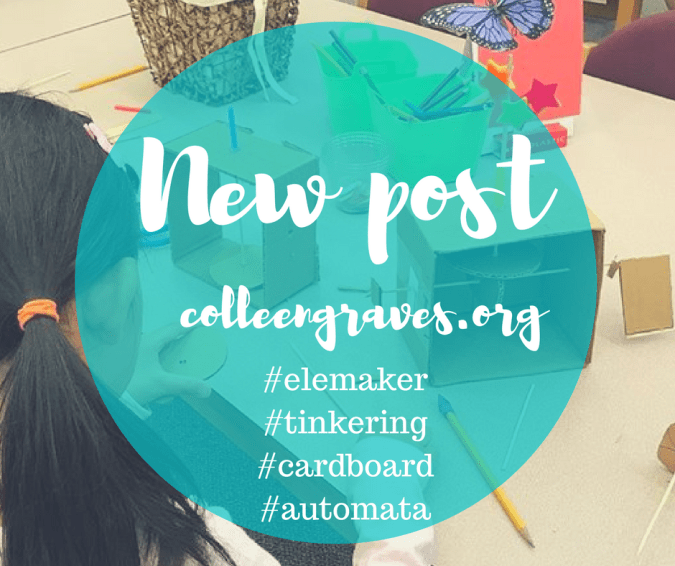
Cardboard Automata – Simple Machines and Storytelling

Join the (6)

Third grade spent about three weeks last month creating their own cardboard automata! It was a powerful combination of literacy and making. As the students were already studying procedural texts and simple machines, I thought it would be the perfect time to teach them how to make their own cardboard automata.

Prep Work

I printed the automata tutorial from The Tinkering Studio to help students build their simple machines. The teachers requested having the students attempt to create the automata by reading and following the instructions since they just finished studying procedural texts.

As I hadn’t made automata on a massive scale yet, I asked some of my maker friends about the best way to get mutliple frames made for quick automata building. J.E. Johnson ended up cutting them for me on long cardboard he uses when he leads his own automata workshops.

The marvelous Aaron Graves cut many many circle and oval shapes so 3rd grade students could focus on building a machine and not just cutting out shapes. (Even though cutting out shapes is a great activity for another time!)

It took quite a bit longer for students to make their automata than I initially planned. I told teachers we would focus on creating the automata in our first session and then the next week, let students focus on the story telling element. I mistakenly thought it would only take two 45 minutes sessions to build an automata with an amazing creative character on top. It ended up taking two sessions for most students to build the machine. While some students were still tinkering and trying to fix mistakes on their machine during the third week of making!

Even though the machines took quite some time to build, it was a great exercise in simple machines AND storytelling.

As the time progressed, the stories got more and more intricate and interesting. Each class had a different dynamic. Some focused on quirky characters, while others had almost a diorama effect. Check out student work below:

Flat Panel Drawing

On the third week of the activity, I told students to create a flat panel drawing as this was the last week we would be working on our automata. I told Mrs. Schlung that I wished we were making automata twice. One build just to understand how to build it and how the machine works. Then have students make it a second time to add more focus on the storytelling element or character on top. Mrs. Schlung suggested that next year it might be better create an automata earlier in the school year with the two-sided flat drawing, and then later in the year we could build a second one with more character development or story background. (Especially as a way of building skills throughout the year.)

StopMotion Automata

Another idea for extending this project is to create stopmotion videos of the working automata. It’s actually a great way to introduce the concept of stopmotion with elemakers. It’s simpler than a LEGO minifig stop motion (which I did with second grade earlier in the year), but still a fun way to learn how to make your own stop motion animations.

If you decide to make your own cardboard automata, make sure you have plenty of patience, and step back often to let your little learners problem solve on their own. This is a great activity for students to make something and gain independence in figuring out how to get their machine to work.  By the end of three weeks, almost all of the students had a working machine, and lots of kids had great ideas on characters and stories their machines would tell!

Those that didn’t finish, start every library visit with, “Mrs. Graves, can we work on our spinny things?”
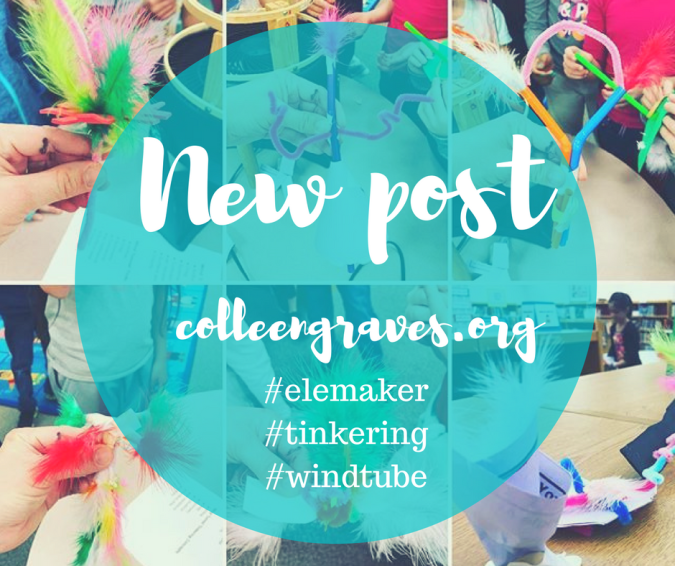
Maker Intro to Rosie Revere, flying things, and a wind tube!

Join the (2).png

Three summers ago, Aaron made our kids a wind tunnel so we could play and tinker with flying things during the heat of Texas summer. We’d seen a few huge versions at places like the Perot museum, Fort Worth Museum of Science and History, and Austin’s The Thinkery. I believe Aaron began building the wind tunnel with these plans from the Tinkering Studio.  It’s basically a cheap fan, some embroidery hoops, and plastic for poster frames that he ordered here.

That summer, our kids flew paper objects, sponges, and beachballs. They crumbled paper, made cones, and tried all manner of things. We brought the wind tunnel to a makerspace we were running at a local conference. The adults we met didn’t seem as interested in the wind tunnel as the young kids who enjoyed exploring properties of fast flying materials. Until I noticed Josh Burker re-iterating flight designs with a multitude of materials, I was unsure how to get adults interested in this quick prototyping tool.  Josh’s wind tunnel explorations focused on slowing down an object, getting the design to float in the wind tunnel, and tinkering with design materials. Over the years, I watched him continually testing materials and trying new concepts.

Then last summer Josh and I led a tinkering workshop for the Pinecrest Innovation Institute. During this massive tinkering sessions, adults explored the wind tube, marble machines, paper circuits, and Makey Makey. I loved watching adults play to learn, tinker with design, and prototype new ideas. At one point, Josh even designed a Makey Makey musical machine inside the wind tunnel!

As school started this year, the plastic in our own wind tunnel was busted, plus I was worried our wind tube design would tip over on my elemakers. As I read Rosie Revere Engineer early on in the school year, I was sad I didn’t have the working wind tunnel for my students so they could iterate flight designs. This is such a great book focused on tinkering and perseverance. Perfect for introducing prototyping flying thingamajigs.

Fast forward to January. Aaron fixed our wind tunnel and luckily for me, I hadn’t read the book to third grade yet. Plus, I’d found a lot of other great books about flying to share with my students. As I thought about the wind tunnel activity, I realized that I wanted to scaffold the flight explorations by grade level. Another consideration was how could I keep the maker mania low so that kids could be wowed by the wind tunnel, BUT still focus on building and rebuilding flying thingamajigs. Oftentimes the excitement of shooting something up the wind tunnel overpowers the experience of design and personal enjoyment of test flights. I wanted kids to focus on perseverance and continually creating different iterations of flying things, not just flinging things into the tunnel (plus, I wanted each student to experience the joy of their own flying thingamajig taking fligh!)  So I came up with a few simple rules to use with all of my classes.

  • Only one prototype in the wind tunnel at a time.
  • Wait patiently at the line for your test flight instead of crowding the wind tunnel.
  • Once you’ve tested your flight design, go back to the tables and redesign it to see if you can get it to fly faster, slower, float, etc. (Or get it to work if it didn’t fly or float.)

Then I broke the activity down by grade level.

Kinder

For kindergarten, I took papers from the recycle bin and cut them into four pieces. Each kinder maker was only allowed the one piece of paper. They could add tape, tear it, cut it, or fold it to see how these simple modifications can effect the flight of the paper.

One of my favorite things about this activity with kindergarteners is that it helped me teach the littles that they can create on their own and test their own ideas. They do not have to have someone else fold, tear, or make everything for them. Many of them asked if I (or the teacher) would fold or cut their paper for them. Instead of doing so, I told them to try their own designs and see if it would work.

View this post on Instagram

Kinder flying thingamajigs! #makered #elemaker #storyofmason

A post shared by Colleen Graves (@makercolleengraves) on

Letting students work completely on their own helps build creative confidence. It also helps them test their own curious ideas, rather than letting the teacher totally guide their learning. It fosters independence, trouble shooting, and problem solving

By the group of kinder, I added small scraps of paper in the center of the table to see how they would adapt to more materials. Students added papers together and called them other inventions.

View this post on Instagram

He said he made a drone! #elemaker #makered

A post shared by Colleen Graves (@makercolleengraves) on

1st Grade

With first grade, I set out only paper and tape. At some point, a student noticed the pencils on the table and decided he MUST make a pencil fly. He tried design after design after design and it wouldn’t work. Then he built this huge and glorious tubular design to make a pencil fly. The other students in his class quickly took on the challenge to make pencils fly. Watch their flying pencils below.

Other students noticed pipe cleaners and added them to their flying thingamajigs. Some flying things began to look like story characters.

2nd Grade

For second grade, I set out a pipe cleaner and a paper. At one point, I changed it back to only paper, then gave them a pipe cleaner after their first successful paper flight.

With the added materials, students began to make things that resembled other objects and other flying things.

View this post on Instagram

2nd grade flying thingamajigs! #makered #storyofmason

A post shared by Colleen Graves (@makercolleengraves) on

3rd Grade

Third grade actually kicked off this activity as they are working on engineering and simple machine concepts for this IB planner. I gave them more materials before I decided to simplify for the younger grades.

I set out feathers, pipe cleaners, foam sheets, and recycled paper. However, since they tend to over use materials, I told them to only take four items to begin making a flying thingamajig. Thingamajigs quickly turned into birds, flying hats, and funny pipe cleaner characters.

This activity really helped kids tinker to better understand the concepts of flight, velocity, surface area, and it helped them tinker with the idea of tinkering! I loved how students would watch their thingamajig fly and immediately set to work on hacking their design to fly higher or float longer in the wind tunnel.

This floating box built by a 3rd grader amazed me because, most students concentrated on height. I loved that this student transferred the idea of the hot air balloon to a floating box.

My own 8 YO, was out during her class’s test flights. But the next morning she designed this beautiful floating butterfly.

What next?

Fourth and Fifth are already asking if they can use the wind tunnel. During the experiments with other grades I had ideas for furthering our tinkering. I wondered what kindergartners might do with pipe cleaner? What if the challenge was to create a floating character? And then write a story about your character’s life? Or maybe even designing a character and then writing a how-to as an example of procedural text? What about flying sentences like the way airplanes used to fly messages behind them?