Advocating for School Libraries- Movers and Shakers 2016

I was extremely honored this week to be recognized along with four other teacher librarians as a Library Journal Mover and Shaker for the class of 2016.

Graves 1final

Photo by Michael J. Madsen

This distinction is awarded to librarians who according to Library Journal, “(are) committed to providing excellent service and shaping the future of libraries.” The 2016 class has 54 members who come from all walks of librarianship!

It is so exciting to be distinguished among this amazing class of librarian professionals and join the Movers and Shakers before me whom Rebecca T. Miller, the Editorial Director of Library Journal and School library Journal points out are “talented professionals who are committed, passionate, and invigorated—each alone and all together transforming the library world and the communities it impacts for the better.” 

I was selected because of my commitment to the library profession, my leadership, and my innovative techniques at transforming traditional libraries into bustling library makerspaces.

From the article: “Colleen Graves has made her mark developing top-notch Maker spaces at Lamar Middle School in Flower Mound, TX, and her current school, Ryan High School, in Denton, as well as lesson plans and other resources applicable to many Makerspaces. Through her Makerspace, Graves has connected not only with her students but with other educators as well. A conversation between one of her classes and the staff at MaKey MaKey led her to write a suite of lessons for teachers using the invention kit. Now, she’s working on two books about Maker spaces and the projects they make possible.”

Read my full profile here.

(Did you catch the Peter H. Reynolds The Dot allusion? And I’m holding Dot the robot?!)

Even more exciting to me is that I earned this distinction along with a class of librarians I hold in high regard.

I wanted to showcase all of the great teacher librarians awarded Mover and Shaker this year because school libraries are so important. A school library should be the hub of your school and your teachers should see your school librarian as an integral instructional partner on campus. These great librarians are perfect examples of why our schools need amazing librarians!!

Andy Plemmons – Andy is a marvelous #elemaker librarian and an amazing proponent of children’s literature. He is talented at bringing the community into the library through author visits, mentor programs, and Skype. Plus, he is very active in teaching his students about being a part of the even bigger global community by participating in global events like Dot Day, World Read Aloud Day, and America Recycles Day. On top of all of this awesome stuff, his library is student centered and embodies the voices of his students because he focuses on empowering his students by making “Student Choice” one of  the main goals of his library. To sum it up, he’s pretty much an all around incredible librarian! Where would his school be without him?

Amanda Smithfield– Amanda is a high school librarian at a magnet school. She’s transformed the culture of her library by adding extra hours, summer checkout, and even a podcast platform for her students to voice their thoughts on self-selected issues. The changes she’s brought about in her library have “increased (checkouts) by 300 percent in the first year and 500 percent more than in 2010.” WOW! Plus, she is teaching her students to use social media for good! Her “students tweet and text her, sometimes asking for help as late as 10 p.m.” Thank you, Amanda, for teaching our students to use our global community for good! What an amazing school library transformation!

Sue Kowalski– Middle School librarian Sue Kowalski LOVES libraries! She believes in the power of a school library and is so well loved, she even won the “I Love My Librarian” award in 2012! Even though her own library and school has been broken up into six different locations for a renovation, she bought an RV and has a traveling bookmobile to keep her school glued to the library. I love how her students help run the library. This is such a great way to give students ownership of the library! Head over to Library Journal and read more about this incredible teacher librarian.

Adam Marcus– As a teacher assigned to the library, Adam Marcus is so passionate about reading and libraries, he helped form a library advisory committee and raise over 500,000 to revitalize the underused space at his NYC school. He even advocated for a full-time librarian position. Plus, he still helps run programs that have students at his school loving literacy and thinking reading is cool.  (Because reading is cool!)

Congratulations to all the other Movers and Shakers honored in this class of 2016! Thank you for your passion towards libraries as innovative and pertinent spaces for our communities. I’m honored to be among you and can’t wait to meet more of you face to face and hear about all of the great things you are doing in your libraries.

Read all profiles here.

LJMAR152016CV

Library Journal March 2016 Cover – Used with Permission


A Library AND a Makerspace

Screen Shot 2016-03-13 at 10.59.17 PM.png

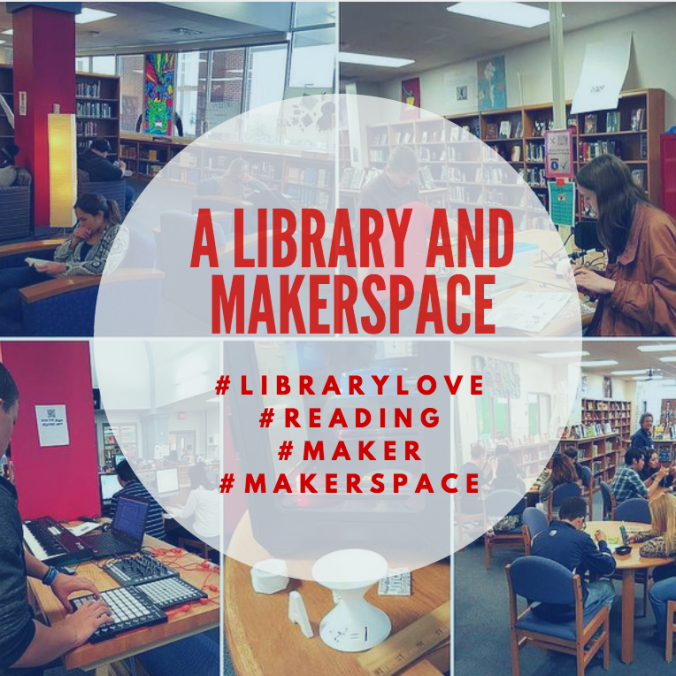
Recently I read an article discussing how libraries are converting to makerspaces. I found this wording dangerous because I love libraries and my library is not just a makerspace. My library is still a library. Yes, we are a learning commons, yes we have a makerspace, but at our core, we are still a library.

Our makerspace is an extension of our library and really a “makerspace” is more of a mindset and philosophy we have towards learning. The makerspace is just one slice of our library pie. We house our maker materials in the library because it is the one place students have access to at any point in the school day.

Goals

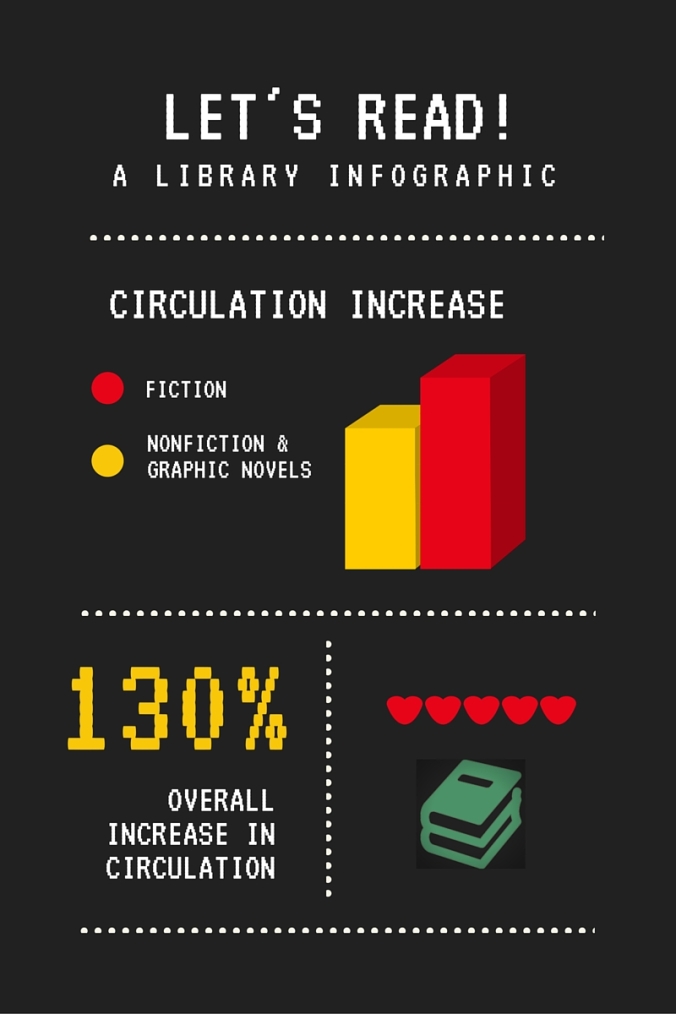
The main goal of my library makerspace is to support and promote literacy. Those literacies include traditional literacies like reading, writing, and research. But also include supporting students in digital literacy, coding literacy, and invention literacy.  However, our main goal is still to get kids to love books and reading. I see the makerspace as an extension of that. When students start inventing and creating, they often need to refer back to research, other projects, etc.  So I keep maker- focused books close to our tinkering tables. I’m happy to report that our overall circulation is up 130%! 

Library

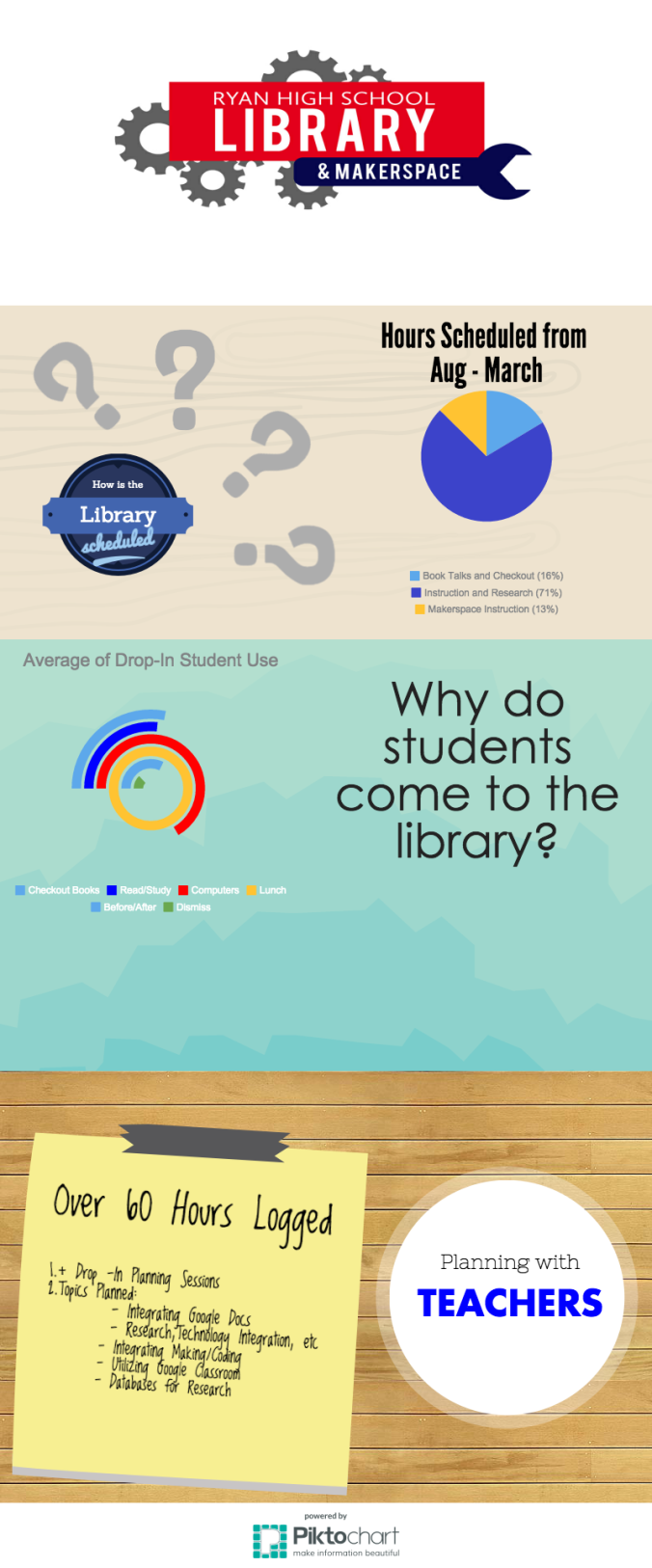
Another pertinent goal for our library is to be a place of support for students and staff. One way we do that is to be a safe place for our students. Every day, around 200-250 students come to the library to read, study, and use our computers. In this ever changing world, the kids still need a place where they know it is safe to pick up a book and learn. They need a place where they feel comfortable to study and learn from one another. Our students here at Ryan are lucky. They have a large commons area just down the stairs from the library where they can commune and eat lunch.  Plus, we let students eat lunch in our library as well. Many of our students visit the library and enjoy our space, and we find that most students who frequent the library are busy, busy, busy little bees -working, studying, and making. One of the things I love most about my library, is that we have kids here studying all of the time. The other day, a student asked me for help with a math problem and another student jumped up quickly and offered her expertise. (Whew! Showing off my inequities in math adverted!)

I’ve logged over 60 hours of planning with teachers and that doesn’t include “fly-by” planning where teachers drop in and we have a quick impromptu planning session.  I love helping teachers integrate technology and hope to get more teachers involved in making next school year!

Quiet Spaces

Some kids come to our library just to read! Yes! That still happens! We have many readers here at Ryan High School. Students grew their love of reading in elementary and middle school because they had excellent librarians and reading teachers that planted this important seed.  AND THEY STILL LOVE TO READ! Because of this, we have a quiet reading spot in the back of our library, located by our gorgeous windows. Students know that they need to collaborate in other areas and that these comfy chairs are just for chilling and reading.

Makerspace Instruction

You’ll notice in the infographic at the bottom of this post that specific makerspace instruction only makes up about 13% of scheduled library time. This 13% includes guided workshops and specific makerspace projects. Outside of this scheduled time, students are welcome to use the makerspace at anytime in the school day and they often do. It’s harder to track this and give it a specific number since the students sometimes come in for one reason and end up staying to tinker in the makerspace.

The Tapestry


I love this metaphor I read this week during #SXSWedu in relation to making. Many teachers and librarians can see threads, but just what is the tapestry of the library makerspace?

For me, it’s a buzzing hub of activity. It’s a space where kids come to:

  • Read
    • We still love books and reading is the most important literacy.  Every library needs a space for readers. Mine is located in the back of the library, away from collaborative areas, but still visible from the circulation desk.
  • Learn
    • We have research classes all the time. My goal for next year is to integrate more making into core classes and to help different core subjects teach with the
      Invent to Learn” method of hands-on learning.
  • Make
    • I was highly influenced by teen spaces like Youmedia in the Chicago Public Library. This type of space focuses on a method that understands kids don’t always realize they want to make stuff. Instead, the space is designed for “hanging out, messing around, and geeking out.” I have students that purposely use our makerspace everyday, but I have many others that stumble upon making. Some come in just to hang out, and then end up tinkering and messing around on our audio editing software and figuring out how to use our Novation midis. Others walk in to have lunch and see a soldering workshop and an empty seat and decide to sit down and learn a new skill. While others walk in to renew a book and notice our new 3D printer and ask how it works and how they can use it. Then they come back to learn about 3D Modeling. This is one of my favorite aspects of the library makerspace. It entices students to come back to the library. Plus, it gives EVERY student a reason to come to the library.
  • Study or Complete Assignments
    • Our library is still a place where students come to study. About 20% of the students that come in say they are here just to study! They love to spread out in our classroom areas and work collaboratively or even tutor one another.  Another 30% of our drop-in students come in to use our computers and complete assignments.
  • Research
    • 71% of our scheduled hours are designated to research. I’m happy to collaborate with English teachers and teach our students how to use our databases and research with books. While more and more students use databases, some of our students still prefer using books.

So how does it all come together in a school day? Luckily for me I have a very large space. Our computers are in the front of the library near the circulation desk. We showcase our new books in what used to be periodical shelving to the left of the circ desk. The students eat lunch here as well and at our new cafe tables. Which means our students eat lunch surrounded by books. Sounds pretty great, right?

Our makerspace stuff is getting organized as we speak (be on the look out for an upcoming post!), and we have some tinkering height tables to the right of our circ desk and in front of my office. Our littleBits are housed in a large cabinet by these tables and a student project shelf is also located here. Plus, as mentioned earlier, I have maker books faced out by these tables as well. It’s the best way to get my new coding and Minecraft books checked out.

I’m lucky to have two classroom areas that are separated from the front sections of the library by book shelves. This makes it easy for me to teach research classes even though other students are having lunch in the library, taking stuff apart at our tinkering tables, taking a reading break, or studying collaboratively. For more info on our spaces, see this visual progress post.


I decided to track just how students have been using the library each month and whipped up this interactive infographic over at Piktochart.


ryan-library-stats-aug-march (1)

View the interactive infographic over at Piktochart.