
As an educator that taught in the English Language Arts classroom for almost a decade, I love exploring and playing with vocabulary and literacy. To me I see making as a logical blend of inquiry and literacy. That’s why I see the library as the perfect place to implement a makerspace in a school.

Exploring Literacy
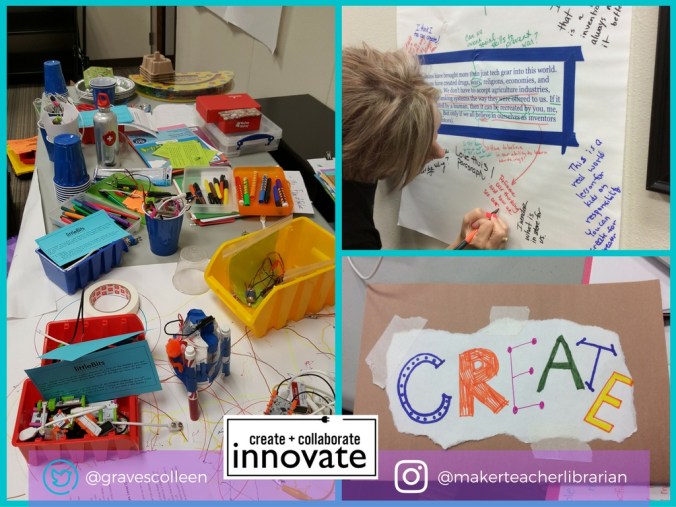
So when I host maker-focused professional development for teachers and librarians, I think it’s important for other educators to explore literacy and “maker” terminology in a playful context. However, it is equally important for all educators to realize that over-defining making and tinkering will close off avenues for our students (Don’t over-define a “makerspace” as a place with only high- tech equipment and close off crafts and creating with cardboard). Instead, we explore terminology as a way to think, learn, and interact playfully with words. To do this, I have participants create maker journals to hold their learning.
“I think my new description of “making” includes “screwing up.” But also, “having fun. It’s important to remember that making includes screwing up, otherwise the fear (that I can’t do this) could take over.” – Amy Fletcher
You can read my whole post on Crafting Professional Development for Maker Educators over on Edutopia!
Documentation and Reflection
Another way these journals hold the learning is by giving educators (and students!) a time and a place to reflect. In case you missed it in the article, I love the way Amos Blanton, LEGO researcher and Manager of the LEGO Idea Studio, articulates the importance of documentation and reflection when learning through play in this video:
Teacher definition explorations from my workshops:
Since the definition explorations aren’t included in the article, I thought you might enjoy reading some of them here:
Making
- “Creating in a unique way with readily available materials.”
- “Seeing things through new eyes”
- “Discovery”
- “Playing to learn”
- “Making is messy”
- “Exploring and creating”
- “Creating by tinkering and exploration”
- “ Risking failure helps you learn”
- “Is writing making? Putting together words to create?”
Tinkering
- “Making sense of nonsense”
- “Building to discover something new”
- “Playing around with something to see how it works”
- “Exploring with no clear path”
Design Challenge
- “There is no right or wrong! Have Fun!”
- “Ask students to create something by trial and error.”
Design Thinking
- “Human centered design”
- “Using the principles of design when solving a problem.”
- “Process of creating, changing, and reattempting an idea.”
- “Identify problem , question, brainstorm solutions, develop prototypes, test with users”
Invention Literacy Article Explorations
- “I forget that re-invention is a part of invention. We can always make it better.”
- “This is a real world lesson for kids on responsibility. You can create for the greater good of society.”
- “Inventing has it’s own language, grammar rules, just like any language.”
- “Thinking of inventing as pieces makes it more approachable and possible.”
- “Becoming invention literate creates confidence.”
- “Encouraging exploration and curiosity decreases fear of the world and each other.”
- “Inventions are the birth of trial and error-things we cannot live without.”
Hands-On Learning
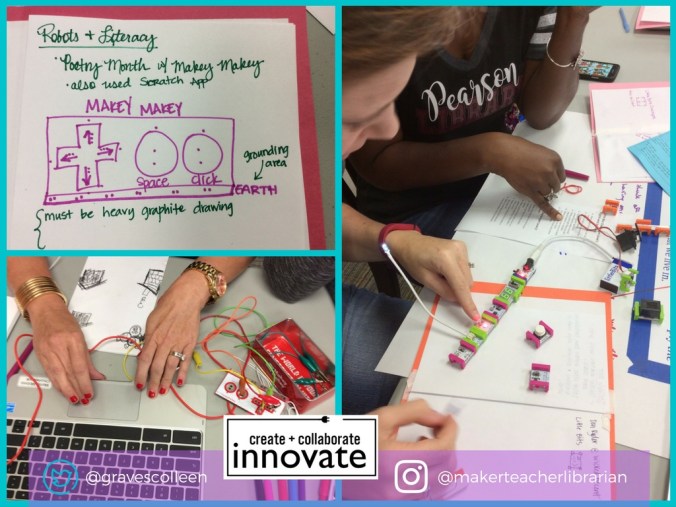
Plus if you are interested in the types of hands on learning I offer in my workshops. Here is a sampling of activities that educators experience in my sessions and then reflect upon in their maker journals:
- Brushbots and Scribblebots
- Paper Circuits
- Makey Makey: How To
- Makey Makey Poetry
- littleBits Challenges (Aaron and I hacked this challenge sheet for the Workshop Set)
Food for Thought
As an aside: I noticed a couple of years ago that”tinkering” has a host of negative definitions. Quite recently I discovered this excellent quote by Resnick and Rosenbaum and would like you to think about this engaging way of learning:
“The tinkering approach is characterized by a playful, experimental, iterative style of engagement, in which makers are continually reassessing their goals, exploring new paths, and imagining new possibilities. Tinkering is undervalued (and even discouraged) in many educational settings today, but it is well aligned with the goals and spirit of the progressive-constructionist tradition—and, in our view, it is exactly what is needed to help young people prepare for life in today’s society.” (Resnick and Rosenbaum in Designing for Tinkerability)
 Last year during our
  Petite Texan: Pack, Pedal, Paddle