Makerspace Storage


maker storage colleen gravesLast year during our Invention Literacy Research, I realized that I really did need to hyper-organize my maker supplies–especially when it comes to recyclables for prototyping! I’d begun organizing our electronics and other gadgets, but it was clear that everything needs to be clearly labeled to make materials more accessible for all students.

Enlisting Help

I may be a librarian, but I’m not the best at organizing, so I enlisted help from our Instructional Technology Specialist, Leslie Terronez. (Have you seen how awesomely she organized our Chromebooks?) I asked for her assistance in creating a labeling system and showed her the awesomely hyper-organized makerspace materials at Lighthouse Creativity Lab. We both loved the way they organized materials by type. (i.e. soft stuff, fasteners, etc.)

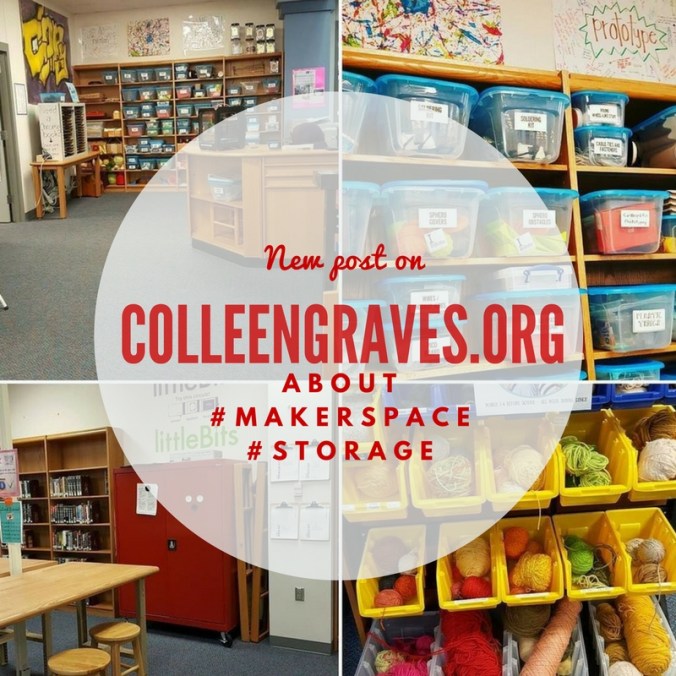
We began moving and inventorying our maker stuff and decided to sort our materials into these main categories: Electronics/ Crafts/ Supplies/ Prototyping/Tools

Since Leslie is an organizing Jedi Master, she decided to organize our labels by type font.

This slideshow requires JavaScript.

Mrs. Smalley and I began the tasking work of sorting our recyclables and other prototyping items into clear plastic storage bins. (This was after extensive time spent measuring the shelves and going to Staples to see what storage box sizes would best maximize our shelf space.)

Maker Materials and Prototyping Tools

I’d say that 1/3 of my Maker supplies are recyclables. Prototyping materials can range from cardboard tubes to weird round wheel like stuff.  Collecting materials like these depend on the types of things your students like to make. Watch their making patterns and gather materials that make sense for their making habits.

You may have a local re-use center where you can find interesting items or just garner ideas for the type of clean upcycling recyclables that work for making. (I just adore shopping at SCRAP Denton. Plus, if my space gets too overrun with reuse materials, I can donate leftovers to this great non-profit!)

Sometimes you won’t know what students need until you start labeling and marking materials. At one point, I was going to recycle some magazines, but decided to bring them up to the library instead. Right after labeling the storage bin, a student had the magazines over at the tinkering tables and was busy utilizing them for a school project.

littleBits

However, organizing electronics is a whole different ballgame.

If you have littleBits and need some ideas, I have a whole Librarian’s Guide to littleBits with tips for organizing, storing, and introducing to new classes. It is available for free download here!

I love these huge cabinets for storing my Pro Library because I can keep Bits organized and locked up if needed.  (And as a bonus, if Bits fall, they are still inside this metal cabinet safely away from feet! Thanks for the tip, #superlibrarianhubs! )

Aaron (the one and only #superlibrarianhubs) also has this great sign inside his cabinet that lets students know that to start inventing they have to pick up a power Bit from the circulation desk.

Sphero

Since Sphero robots need to be charged and ready to go, see my previous posts about organizing, circulation, and using Sphero with classes. (and Sphero Obstacle Course Challenge and Participatory Learning)

In Progress Shelf

While it isn’t storage per se, a makerspace isn’t complete without a “Works in Progress” space.  At Lamar, I had this space designated for works in progress. It really doesn’t take long for this space to get out of control… so you do have to do some regular maintenance if you see “in progress” projects sitting for a long time. I’m still working on this space at Ryan, (kids are already utilizing it, but it isn’t picture ready…) but I will update this post when it’s ready to share!

Sharing Awesome Student Work

It is equally important to have a space dedicated to sharing awesome student work! I’ve spent the last few years showcasing student work digitally, but I’m now in the process of making a permanent maker display to share what students at Ryan are creating. I’m hoping it will inspire even more students to come to the library to be creative and learn through hands- on experiences. If you haven’t seen my Instagram, I post daily things my students create and other library related madness.

How about you?

What are your plans for makerspace storage? What works for your students? How do you share student work? Please share your ideas in the comments below! 🙂
#CapMakerFaire and #NationofMakers Wrap Up – The Future of Making

Last month, I had the distinguished honor of being invited to speak in DC before the Capitol Hill Maker Faire as part of the week long celebration of making.

Congressman Takano opened the daytime panels by discussing why he helped co-found the Congressional Maker Caucus. What was interesting to me, were some of the constants I’ve observed from working with new makers and working with companies like Makey Makey and littleBits. Here are some of my favorite sound bites from Congressman Takano:

  • “New technology scares the general public.”
  • “It is not simple to label, but it is easy to recognize the energy of this movement.” (In regards to the maker movement)
  • “Are we ready to take making to the next level?” (and how?)
  • “Each of us can be CREATIVE and INNOVATIVE regardless of age.”

Throughout the day, listening to experts from the maker movement on these amazing panels organized by the IMLS, I heard 3 big concepts reiterated across the varied fields. (See the full line up of panel speakers here.)

  • Inclusivity (The maker movement is for EVERYONE)
  • Accessibility and democratization of tools needs to happen
  • Community based = Maker Success
  • Open Access and sharing are key

Community-Based

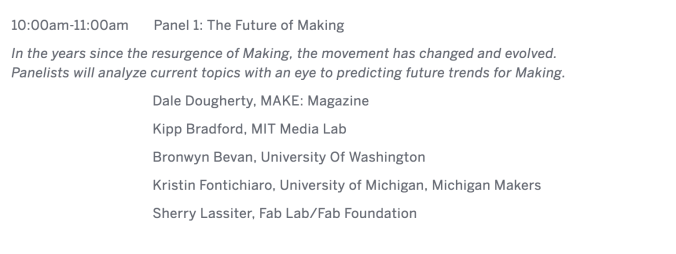
When founder of Make Magazine Dale Dougherty, asked the first panel how we can expand and grow makerspaces in schools and libraries across America, this panel had a powerhouse of answers.

Screen Shot 2016-07-05 at 7.26.45 PM.png

Sherry Lassiter stressed the importance of communicating, collaborating, and cooperating to build universal access for makers.

Capitol Hill 1_colleengraves

“Making is not about tools, but PEOPLE and the EMPOWERMENT that comes from making something with your own hands.” Sherry Lassiter

She also stressed the importance of letting students be the maker mentors for other students. (Something I’ve seen among my own students at both school makerspaces I’ve started. Letting students LEAD the learning let’s students OWN the learning.)

Kristin Fontichiaro, clinical assistant professor and faculty founder of the Michigan Makers project for elementary and middle school makers in under-resourced schools brought up many important points I’ve been focused on as of late.

  • Our “low income students are filled with high creativity”
  • “Rural communities have very different budgets and access.  They are diverse, rural, and underserved.”
  • “Some rural communities have no cell, data or Internet access.”

Bronwyn Bevan, currently Senior Research Scientist at University Of Washington (previously Director at S.F. Exploratorium) discussed the benefits of learning through making. 

  • “It encourages entrepreneurship.”
  • “Engineering is collaborative.”
  • “Hands-on STEM is the next generation of K-12.”
  • “Science is the process of learning about the world.”
  • “Tinkering is open ended and has no blueprint.”
  • “Self directed learning helps students LEVEL UP.”
  • “Educators need to create a culture of “What if?”
  • “Students need to feel empowered and supported to ask questions.”

Kipp Bradford, a research scientist at MIT Media Lab, discussed how one of the most essential aspects in the success of the future of making is that, “we need to connect our makerspaces with communities and make tools accessible.”

He also stressed that “engineering is about making the world better for humans. It is important that in all the push for STEM, we don’t lose humanity.”

The next panel continued to stress accessibility and community-driven makerspaces. Greg Mickells of Madison Public Library said something I’ve been trying to communicate everytime I’m asked to speak. “Making is not about the stuff, we should focus on people.” At the Bubbler at MPL the goal in making is “to learn, share, and create.” Patrons are encouraged to “design like MAD” in this “dynamic library environment.”

Accessibility

So how can we increase accessibility to maker education? Should we put a makerspace in every school library and public library? Could you imagine how awesome that would be?

Lisa Brahms of Make Shop Pittsburg part of the Children’s Museum of Pittsburgh proclaimed, “the point of a library is to point people towards resources.” So doesn’t that mean that a library is a natural fit for a makerspace?

I loved how Kipp Bradford went ahead and stated the obvious, “Why don’t we just make the investment to fund innovation?” What is holding us back?

Screen Shot 2016-07-06 at 10.05.44 AM

It is pertinent however, that all schools, libraries, and public officials realize that it isn’t as easy as just creating a space and letting people in. As design education evangelist  Jeremy B. Carter from Autodesk states, “You can’t just open doors, you have to MAKE it happen.”

Building a culture of creativity and making takes work. You need a facilitator (or librarian ) to help grow your makerspace. You cannot expect a successful space if you do not have a passionate maker leader driving your maker bus.

Training for teachers and staff should focus on equitable and culturally responsive makerspaces. When instituting a new makerspace, administration and teachers should discuss building a culture of making and inquiry that builds a maker community in their school. Getting students involved in the process will also drive your makerspace success and allow students to become leaders and experts in the space from the get go.

Capitol Hill 3_colleengraves

Education Panel

I had a blast sharing my own passion for making in education with the all star panel organized by the IMLS:

Screen Shot 2016-07-05 at 7.26.37 PM

Once again, our panel brought up the need for involving the community – and not just the local community, but expanding to the global maker community. We also stressed the importance of process over product, failing forward (or as Congressman Takano put it, working from the “failures you learn from and successes you build on.”

Don’t be afraid to learn alongside your students. Even if it means exposing yourself to failing in front of them. This is a good thing. Kids need to see us fail and move on.

Throughout the course of the day, I heard a lot about marketing, manufacturing, and entrepreneurship, and while I appreciate that the maker movement facilitates these things….  it is not why I believe that making in education is relevant and indispensible.

You see, I used to have an Etsy shop and make things for others, but what I love about the maker movement is not making things for others.

What I love is teaching others to make things for themselves. That’s why I enjoy being an educator even more than being an artist or a maker. I think a lot of this stems from my love for the transcendentalist movement founded on the ideas by Thoreau and Emerson who believed that humans should think for themselves AND be self sufficient.Capitol Hill 4_colleengraves

While I would love for my students to grow up and invent the next big thing, thinking that all of these kids caught up in the maker movement will grow up to be the next Elon Musk is a bit far fetched. That is like assuming all students who take math will grow up to be mathematicians.

Instead, we should focus on the fact that these engaging activities are essential skills for all of our students to gain!  Making teaches students to work collaboratively in ways that our curriculum often doesn’t. Many times, our students leave our schools lacking the ability to problem solve, work in a group, act as a leader, and deal with failure because it isn’t in the curriculum.  

The good news is that these are all skills students can build through making.

Evening Maker Faire

In the evening, Aaron and I taught Maker Faire attendees how to make their own simple paper circuit and even how to make a simple DIY switch. One of the highlights for me was teaching fellow Dentonite and Congressional Science Fellow David Visi how to make a paper circuit. Another highlight was watching Aaron teach a gaggle of Girls Scouts about circuitry. Thanks so much to Chibitronics for providing some circuit stickers and if you are interested in our templates they are in our upcoming book – The Big Book of Makerspace Projects to be published in October 2016.

Thank you again to the IMLS for organizing such a great day! It was a blast and wonderful experience and I hope I am able to attend the next one!