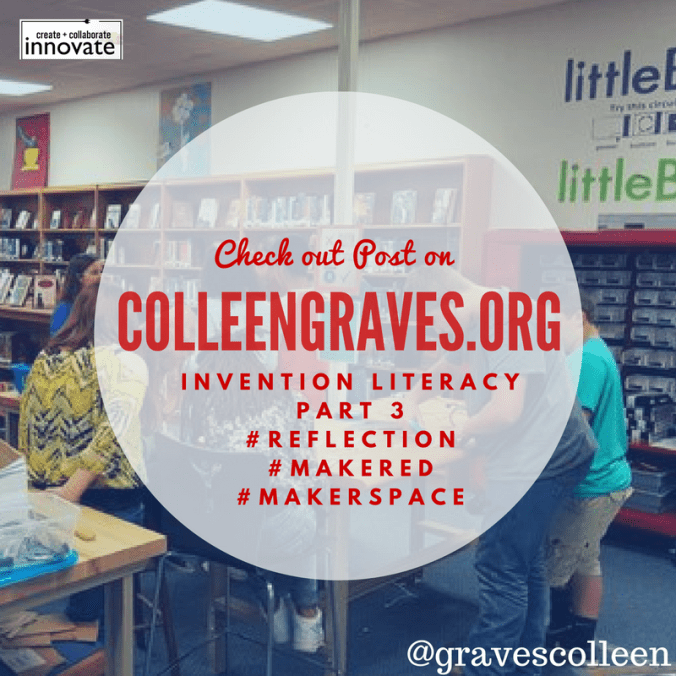
This is the third post in a series describing the Invention Literacy Research Project that I worked on collaboratively with one of my English Teachers in the 2015-2016 school year- April Feranda. About 6 months ago, I watched this video by Jay Silver defining the term “Invention Literacy.” I immediately loved this concept because it perfectly describes what I’ve been attempting to do in my library makerspace since May of 2013. After writing lessons for Makey Makey in 2015, I realized I went through the ultimate training on Invention Literacy and boosting creative confidence. I wanted to share that journey with you to help you become invention literate as an educator. April Feranda and I would love for you and your students to become more invention literate. Therefore, we are putting this out there for you to hack and personalize and make your own. Read post one and post two if you haven’t had a chance to read them yet.
After researching and learning from the tinkering experts at The Tinkering Studio, students spent two class periods (and plenty of time after school) finishing prototypes for our finale Maker Fest. One of the coolest things about this project was that students were picking up making skills as needed. The student in the video below needed to learn how to use our saw while creating marble runs, so I was able to teach some saw safety on the fly!
I was also pleasantly surprised when students stayed after school and we made up quicker ways to create soft circuits by utilizing conductive fabric tape from the Makey Makey Inventor Booster Kit and hardware store foil tape.
Sharing Maker Fest
On the due date, Mrs. Feranda and I decided to hold a Maker Fest and just like at a real Maker Faire, students presented their prototypes in a show and tell style fashion. If you hold your own Maker Fest, you need to make sure you:
- Get others involved
- Invite community
- Invite inventors via Skype
- Invite other Students or classrooms
- Have students be prepared to speak about invention literacy, historical context, and the most challenging part of creating an invention
- Make GIFs of prototypes ( with Spin turntable or another documentation) to keep a digital record of inventions.
Some of my favorite projects were made out of all recyclables (this helicopter and water turbine), while others combined favorite maker tools with recyclables to make miniature versions of everyday things! (Makey Makey piano and littleBits tank below)
Surprise Virtual Guest Jay Silver
During our Maker Fest, we had a surprise virtual guest, Jay Silver! I carried him around via my computer so he could chat with each group or individual about their #rhsmakes. He did an awesome job casually chatting with kids about what they made. Students really enjoyed sharing their creations with this awesome inventor and Jay was great about asking students about their invention process. One of my favorite things was how he asked each student questions pertinent to their own invention.
If you implement this project at your school, it is important that you and your co-teachers understand that the process and the meaning a student gets from making are one of the most important aspects to making and education. The final product can be faulty and that’s okay. One of our students during this project decided she was going to build magnetic gears. She never got a working prototype, and was a tad upset about the outcome. However, when we Skyped with Jay Silver during our Maker Fest, he was extra impressed with her idea and original concept. He spoke at length to her about her process, her thinking, and her many attempts that ended in failure. Through this conversation, she was able to see how much she learned throughout the project. During the project, Feranda and I worked on explaining this to all of our students, and explaining that persevering after failure is what leads to innovation.
This whole research project was the perfect blend of academic research and crowdsourced research. For example, after researching how cars were made, the student below wanted to build a littleBits car. He found a crowdsourced Youtube video and tried to replicate the car from the video, only to find that there were missing steps, and parts he did not have access to. Instead, he ended up looking at gears and mechanisms, then found his own way to make and create a tank out of an old 3D filament box.
Reflection
After our Maker Fest, students went back to class to finish out the school year. Since reflection is an integral part of the process, we gave them a break and then had them create video reflections via Flipgrid. We are hoping to compile these videos and use them as a springboard for this year’s Invention Literacy project. Here are the reflection questions we used:
- What did you like most about the Invention literacy project?
- What was the most challenging part of the project?
- What advice would you give to someone making their own invention?
- What does someone need to know in order to be invention literate?
- Any final thoughts or advice for Mrs. Feranda and Mrs. Graves?
(If you want to read more about reflection and makerspace stories, check out this great article from Edutopia by Ross Cooper and Laura Fleming and read my Edutopia article about using maker journals as a form of reflection during maker education professional development.)
Sampling of student responses:
As I sat in my office and watched these Flipgrid reflections, I was struck by the authentic research methods of my students AND how invested they were in research as an integral part to making! This maker-focused research was like an accelerated course in making. Some of these students had not utilized the makerspace until this project and the little nuggets of wisdom they gained from this project were all the things a maker teacher librarian wants to hear from students:
- “You have to be okay with failing”
- “You need to be flexible with mistakes even if you mess up. Even if you have to start over and do it again. And you need to be creative to think about how you are going to build your project. Because not all projects come with instructions.”
- “You have to tweak it (projects) and make it your own.”
- “The most challenging thing was learning from your mistakes, but that helped you later in the project.”
- “Research…that’s all you need…. and also planning… you might want to make blueprints, gather materials, and think about what you want to create. Not like what I did!” (In response to: What advice would you give to someone making an invention?)
- “It’s okay to fail. Even if you have to start over and over.”
- “My advice is to do really good research on your project and maybe draw out what you want to create, and be patient with yourself because you are going to mess up and it’s going to be a long process. ” (This is one of my favorite reflections. )
- “If you don’t do enough research, you won’t have the ability to collect all of the materials. Because some dude out there may have ideas you didn’t think of that will work for your project.”
Extending Invention Literacy into Daily Practice
So….what are we doing this school year to support invention literacy?
Here at Ryan High School, we want to increase invention literacy by teaching all of our incoming freshmen (an estimated 500 students) the basics of programming, prototyping with littleBits and Makey Makey, creating and editing greenscreen videos, and utilizing design thinking to solve community problems. As we continue to work through this process each school year, we hope to teach all of our 2,000 students the “basic vocabulary and grammar of inventing” so that all of our students can help contribute and create our world!
With the help of teachers, all of our freshmen in High School 101 classes have not experienced playing with Makey Makey, littleBits, and Greenscreens. I’m hoping to up their coding skills soon by teaching them to create programs in Scratch. I’m looking forward to planning with more teachers on collaborative research projects and working with the awesome Mrs. Feranda on Invention Literacy Research 2.0.
What will you do? How will you prepare your students and increase invention literacy on your campus?
 Last year during our
  Petite Texan: Pack, Pedal, Paddle