Makey Makey GIF Stations aka Personal Photo Booth

colleengravesposts (4).png

“You’re on Candid Camera!”

One of the first lessons I brainstormed for Makey Makey was the ELA Candid Camera Lesson. In the beginning, I only had a loose idea of creating a candid camera that students would activate via a switch. I thought it would be fun to take candid pictures and then tell a story later on based on the “found” images from the classroom. Don’t take this the wrong way and set up a secret camera in your classroom. Students will need to construct it and KNOW that it is there! I love the idea of letting students create GIFs with whiteboard scraps and reviewing books this way. Or even creating stop motion animation!

Reenactment Strategies

I wanted to take the lesson further though, so I thought back to my time in the ELA classroom and some great “Deepening Comprehension Strategies” from educator Jeffrey Wilhelm.  My Language Arts students THRIVED when they acted out stories, sat in the hot seat, or acted like experts. I loved how silly and fun they would get when reenacting with the “tableaux” strategy.

In this Makey Makey lesson, tableux meets technology and students create personal photo booths to make GIFs of acted out plots, vocabulary, or other narrative elements.

Incorporating the Lesson – Maker Style

Fast forward to this school year, I was stoked to hear that some of my new ELA teachers were using tableux to understand and re-emphasize the plot structure in “And Then There Were None.” So I shared my GIF station lesson idea, and Mrs. B and Mrs. F were ready to bring their classes to the library.

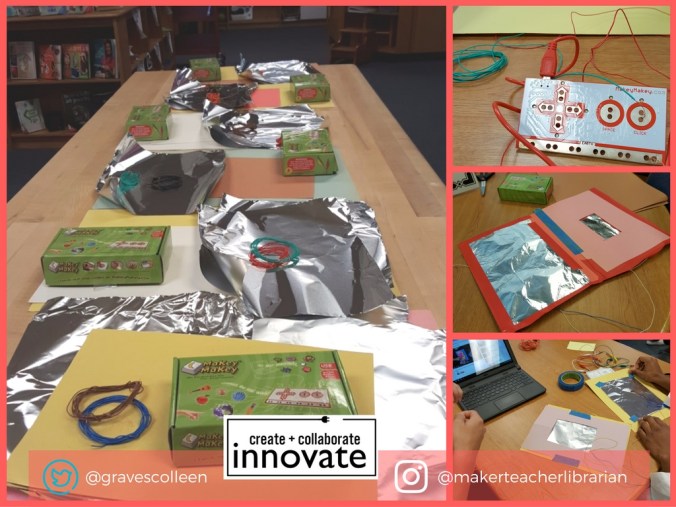
While I would love to have time to teach all of the students how to strip telephone wire for Makey Makey, I realized that we wouldn’t have enough time to do this AND create our GIF stations for tableux. (After all, what was important in the lesson? Stripping wire? Or solidifying narrative concepts?)  Instead, I enlisted my student aides to strip old telephone wires and Ethernet cables and gather supplies for our classes. My aides prepared supplies for each group:

  • Two long strips of telephone wire- with ends stripped
  • Two pieces of aluminum foil
  • One long piece of construction paper
  • One half sheet of construction paper
  • One Makey Makey Kit
  • Low adhesive tape

colleengraves.org MakeyGif prep.jpg

Hands On Learning

While you could explain how to create a switch with Makey Makey and tell students what to do….. it’s a little more fun and a little more engaging to let them figure it out and problem solve a bit. So, I had groups grab a Chromebook and navigate to my Youtube video below. I also kept a finished “GIF station” example available for them to look at if they got stuck.  As with most maker activities, some groups got it quick and others required a little more assistance.  I stayed nearby to help groups that got stuck and I prompted students to debug what was wrong as needed.

Debugging

If you try this yourself, your students will probably run into these problems:

  • Making constant connections in the DIY switch
    • Too big of a hole in the middle paper
    • Foil taped too loosely
    • Foil pieces touching on the inside of the fold
  • Camera not activating
    • It only works like a “click” so make sure to hover over the camera click!
  • Connectivity issues
    • Some students don’t realize that the copper wiring is what needs to be taped to the foil!
    • Always have students double check which pins they clipped alligator clips to!
    • Make sure one wire is connected to earth! Stay grounded!
    • Be sure they’ve plugged in the USB! (You’d be surprised how many times I’ve personally forgotten to do that!)

Tableux and GIF

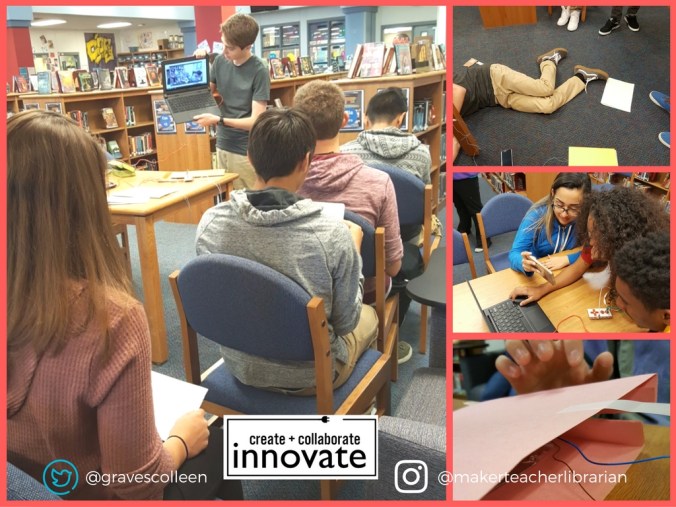
Once their GIF stations were made, students spread out around the library and reenacted their scenes and took pictures. The GIF stations made it so that all of the students could be a part of the reenactment. Some groups enlisted even more help by working together and the students thought their pictures were so funny, they took snapchats of their Chromebook scenes. Creating the GIF from the pictures on the Chromebook proved to be taxing since GIFPAL is blocked at our school, but the Makey Makey personal photo booth was a success!
colleengraves.org makey (1).jpg

Go Further

What else can you do with a personal photobooth? Mrs. Richmond decided to make a “Checkout Selfies Station” so students could show off what they checked out!
Makerspace Storage


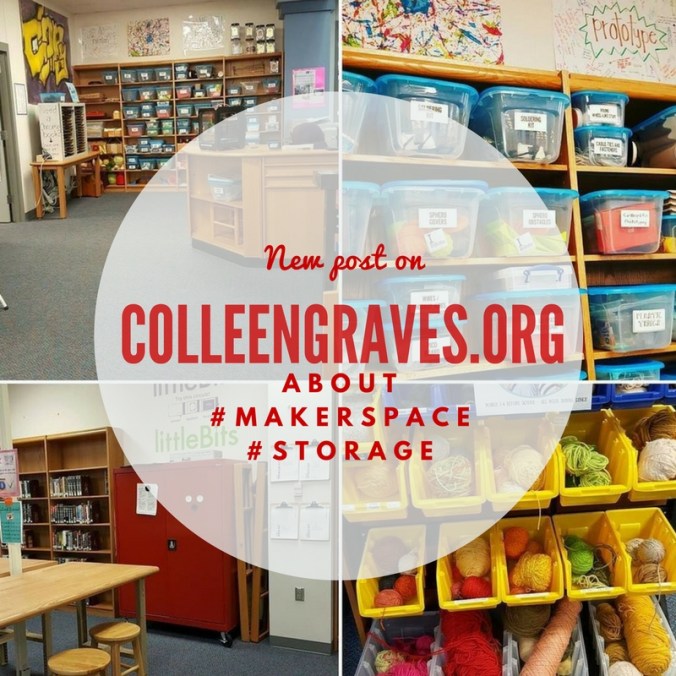
maker storage colleen gravesLast year during our Invention Literacy Research, I realized that I really did need to hyper-organize my maker supplies–especially when it comes to recyclables for prototyping! I’d begun organizing our electronics and other gadgets, but it was clear that everything needs to be clearly labeled to make materials more accessible for all students.

Enlisting Help

I may be a librarian, but I’m not the best at organizing, so I enlisted help from our Instructional Technology Specialist, Leslie Terronez. (Have you seen how awesomely she organized our Chromebooks?) I asked for her assistance in creating a labeling system and showed her the awesomely hyper-organized makerspace materials at Lighthouse Creativity Lab. We both loved the way they organized materials by type. (i.e. soft stuff, fasteners, etc.)

We began moving and inventorying our maker stuff and decided to sort our materials into these main categories: Electronics/ Crafts/ Supplies/ Prototyping/Tools

Since Leslie is an organizing Jedi Master, she decided to organize our labels by type font.

This slideshow requires JavaScript.

Mrs. Smalley and I began the tasking work of sorting our recyclables and other prototyping items into clear plastic storage bins. (This was after extensive time spent measuring the shelves and going to Staples to see what storage box sizes would best maximize our shelf space.)

Maker Materials and Prototyping Tools

I’d say that 1/3 of my Maker supplies are recyclables. Prototyping materials can range from cardboard tubes to weird round wheel like stuff.  Collecting materials like these depend on the types of things your students like to make. Watch their making patterns and gather materials that make sense for their making habits.

You may have a local re-use center where you can find interesting items or just garner ideas for the type of clean upcycling recyclables that work for making. (I just adore shopping at SCRAP Denton. Plus, if my space gets too overrun with reuse materials, I can donate leftovers to this great non-profit!)

Sometimes you won’t know what students need until you start labeling and marking materials. At one point, I was going to recycle some magazines, but decided to bring them up to the library instead. Right after labeling the storage bin, a student had the magazines over at the tinkering tables and was busy utilizing them for a school project.

littleBits

However, organizing electronics is a whole different ballgame.

If you have littleBits and need some ideas, I have a whole Librarian’s Guide to littleBits with tips for organizing, storing, and introducing to new classes. It is available for free download here!

I love these huge cabinets for storing my Pro Library because I can keep Bits organized and locked up if needed.  (And as a bonus, if Bits fall, they are still inside this metal cabinet safely away from feet! Thanks for the tip, #superlibrarianhubs! )

Aaron (the one and only #superlibrarianhubs) also has this great sign inside his cabinet that lets students know that to start inventing they have to pick up a power Bit from the circulation desk.

Sphero

Since Sphero robots need to be charged and ready to go, see my previous posts about organizing, circulation, and using Sphero with classes. (and Sphero Obstacle Course Challenge and Participatory Learning)

In Progress Shelf

While it isn’t storage per se, a makerspace isn’t complete without a “Works in Progress” space.  At Lamar, I had this space designated for works in progress. It really doesn’t take long for this space to get out of control… so you do have to do some regular maintenance if you see “in progress” projects sitting for a long time. I’m still working on this space at Ryan, (kids are already utilizing it, but it isn’t picture ready…) but I will update this post when it’s ready to share!

Sharing Awesome Student Work

It is equally important to have a space dedicated to sharing awesome student work! I’ve spent the last few years showcasing student work digitally, but I’m now in the process of making a permanent maker display to share what students at Ryan are creating. I’m hoping it will inspire even more students to come to the library to be creative and learn through hands- on experiences. If you haven’t seen my Instagram, I post daily things my students create and other library related madness.

How about you?

What are your plans for makerspace storage? What works for your students? How do you share student work? Please share your ideas in the comments below! 🙂