Chibitronics Paper Circuits, #CircuitGirls, and Aiding #Girlsintech

ColleenGraves chibi review1

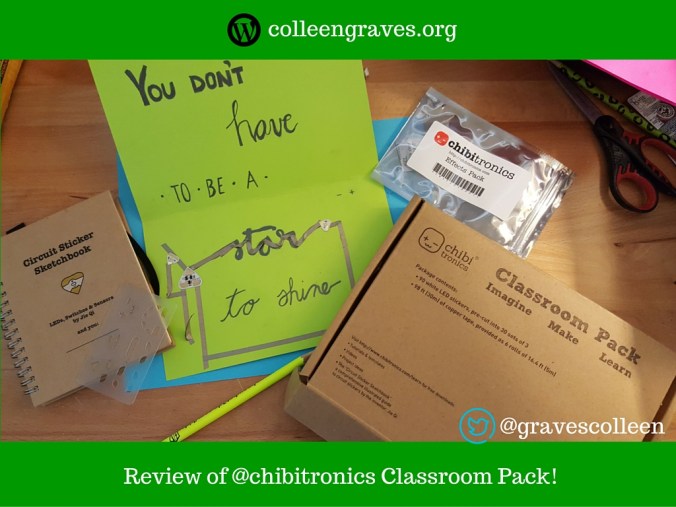
Chibitronics Classroom Pack Review

Whoa! This classroom pack from Chibitronics is the best thing since sliced bread! It has 90 LED circuit stickers and 6 rolls of super skinny copper tape!

If your students worked through the STEM Starter Kit, then this would be an excellent way to get them to start designing their own circuits! This is also an excellent tool to run a paper circuit workshop even if your makers haven’t used the kit since Jie has most of the templates available at Chibitronics for free!

While you can use regular LEDS to make paper circuits, I love how easy Chibi stickers make crafting your own paper circuitry. Plus, they lay flat so it’s easier to make art with them. (I love combining paper crafting and circuits for the ultimate STEAM activity!)

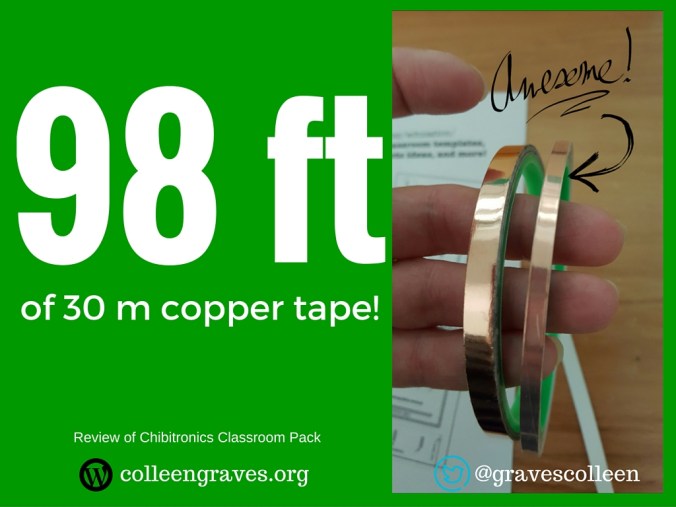
My favorite thing about the Classroom Pack are the super skinny rolls of copper tape. For the last two years, I’ve been telling my students to cut their copper tape in half. This skinny tape is much easier than that extra step, plus it’s easier to lay smooth and fold corners. You can see in the pic below that the tape on the right is half the width of the tape on the left. Plus, since the pack comes with 6 different rolls, you can set out a roll of tape for 6 different tables of makers!
ColleenGraves chibi review2

I can’t wait to do some paper circuits with my students this month at Ryan Library Makerspace!

Chibitronics Effects Pack

I also bought the effects pack and had a great time tinkering with ideas for my May-ker Display I’m working on for the last library display of the year. Pretty sure I’m going to have to write up a Donors Choose grant to get a bunch of these packs for my RHS makers!

Note: I didn’t really have any direction for this paper circuit project, I just knew I wanted to use my new effects pack and creative lettering techniques from this book a student requested for the library. My 5th period aide came up with the quote, and I decided to use my Makey Makey soft conductive tape so I could make a circuit through the lettering. Then for the “night time sky” I attempted some constellations and used the awesome skinny tape from the Chibitronics Classroom Pack. The effects stickers are just plain rad and it didn’t take me long to design a working circuit, but that’s probably because of all of the Lilypad Arduino projects I’ve been working on. I probably wouldn’t introduce this effects pack and this concept to my makers at RHS until they’ve designed many of their own working paper circuits!

My History with Chibitronics

I started using Chibitornics notebooks last year when I realized that I needed to “make” room for girls in my makerspace at Lamar. I wrote a Donors Choose grant and was able to start a girl’s tech group called “Circuit Girls.” Every week for the rest of the semester, the girls and I learned about circuitry by creating circuitry art in Jie Qi’s awesome Circuit Sticker Sketchbook. We learned about simple circuits, parallel circuits, and even DIY Pressure sensors. Jie is so awesome she even has these templates available for free on the Chibitronics site! Plus, I love Chibitronics Circuit stickers so much, I’ve included an entire chapter on Paper Circuits in The Big Book of Makerspace Projects using Chibi stickers as supplies. (I can’t wait for you to see these templates with Aaron’s art! If you look close on the cover, you’ll spy one!!)

The Circuit Girls are Lamar were also my first Donors Choose recipients. Normally, it is hard for a library to budget for consumables. For this reason, I crowdsourced our funding so each girl could take home their circuitry notebook at the end of the school year. One of my favorite things about this was that it not only shared what we were doing at Lamar, but the girls would use their new knowledge to create their own light up thank you cards for our donors. Here are a few of their examples:

At the end of the year, I was happy to hear the students enjoyed Circuit Girls as much as I did! I’m also happy to know that the Circuit Girls are still alive and kicking with the new librarian at Lamar, Kristi Taylor.

Kristi’s Circuit Girls Promo for this school year:

So now you can see a little about why I love this light up notebook.  It’s a great way to get girls involved in STEM.

Whenever I host a workshop, I share Chibitronics templates because paper circuits are an excellent way to learn about circuitry! Then students can go even further by learning to sew circuits, and even further by exploring Arduino microcontrollers to create soft circuit wearables or stuffies. (Yep, we have a chapter dedicated to sewing circuit projects in our book too!)

At my high school, I’m getting girls involved in STEM by running #GirlsinTech camp. This way Kristi and Lamar can hold onto the Circuit Girls hashtag and track their fun. I’m not having weekly meetings yet either as the best way for me to get girls involved is to host afterschool camps that I schedule ahead of time. I’m hoping next year that we can get a weekly club going. During our 1st camp, we tinkered with paper circuits and chatted with Jie from Chibitronics, check out the video below for excellent tips from this artist engineer on paper crafting.

I’ll be speaking more about getting girls involved in maker programming at ISTE this summer! So come check that out too!

Disclaimer: I did not receive any funding or endorsement for this review. Chibitronics sent me this pack after seeing multiple posts on Twitter about my love of paper circuitry!

Hands-on Learning and Boosting Creative Confidence

I can

Leander Conference

What a week! I started the week by leading “Hands-on Makerspace Learning” for teachers and librarians in LeanderISD. I enjoyed sharing ideas with them, and then watching them gain creative confidence as they tinkered with materials to make paper circuits, simple robots, and even got silly programming bananas to play their laughter with Makey Makey. The teachers enjoyed tinkering with the new “Temperature sensor” littleBit and taught me a few things about how it works!

One of my favorite a-ha moments this week was seeing the natural collaboration that occurs when educators (or students) are making stuff. When students have to figure out how things work together, they gain the confidence to teach others the basic concepts, and they gain the confidence to persevere through problems. As a teacher, my favorite aspect of this, is hearing all the thinking my students go through as they try to solve a problem. Plus, it’s amazing to be able to hear the natural questions that arrive from those think- aloud sessions.

And even better than that? The smiling and giggles and laughter when they reach success! These Leander teachers realized they could even record their laughter in the Scratch program and then “play” the Play-doh to ignite the recording of their laugh!

So much fun learning/sharing #makeymakey w #LISDCIC Ts & @leanderisd_libraries today! #makered

A photo posted by colleengraves.org (@makerteacherlibrarian) on

Makey Makey Session

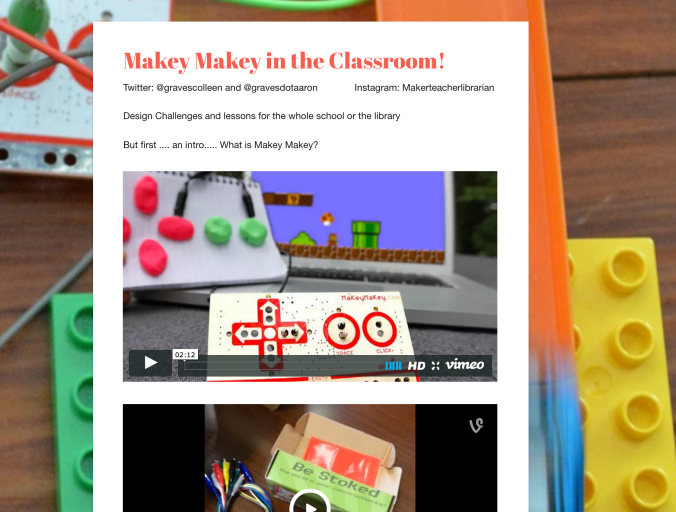
At TCEA on Wednesday, the #superlibrarianhubs and I led an hour and half workshop on utilizing Makey Makey in the classroom. We talked to teachers about how to get started with Makey Makey, how important it is to teach invention literacy, and to never ever ever eat the gummy worms from our Makey Makey workshop! HA!

One of the best things about this session was showing educators that teaching with Makey Makey is accessible! We gave them the confidence to go #beyondthebanana. As we walked the room helping session attendees create Scratch games for their celery, gummies, and bananas, we stumbled upon some great brainstorming sessions between educators!

I really love this sketch note from our session by Vanessa Perez. (What a great way to showcase her learning, but also share her learning with others! Teachers, I will be bugging you to use sketchnotes in your classes! For those of you that are new to sketch notes, it is not an app, it is an idea- it’s simply sketching your notes in a visual and non-linguistic way. As a learner, it’s a great way to focus on what is important and help retain ideas from a session or class!)

cax4ftlumaau0pd

Awesome Sketch Note by Vanessa Perez @vperezy

All of the lessons we shared are over on the Makey Makey page, but here is a copy of our presentation with pictures and others links if you are interested. Some of my favorite lessons are the Classify and Sort Lesson (because it makes students draw geometric shapes and then program them,) the Dual Language Lesson, and utilizing Makey Makey Hot Wheels switches for Distance, Rate, and Time.

Screen Shot 2016-02-05 at 8.18.00 AM.png

Tackk for Makey Makey Session

Plus, you should take a look at the smiles and FRUIT from our Makey Makey session:

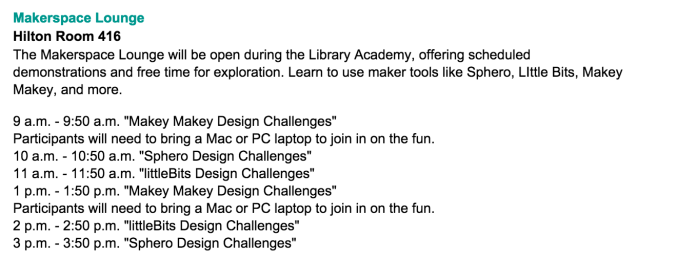
Makerspace for TCEA Library Academy

Thursday was a busy, busy day! We ran focused workshops every hour, but librarians were free to play with anything in the room. Some librarians stayed with us for a good 3 hours learning and making. Then they walked around the room and shared their new knowledge with other participants that were new to our pop-up makerspace.  Aaron, my ITS Leslie, and I were always nearby in case makers got frustrated and needed assistance. Having small, focused groups, helped librarians feel comfortable enough to sit down and explore. Sometimes, our educators just need time set aside for learning, I heard many people say things like, “Oh, I’ve seen littleBits/MakeyMakey before, but I don’t know what I would do with them.” Then they sat down, made things, and realized the power behind these cool inventions!

It was amazing to be able to offer new maker librarians a safe space to do some hands-on makerspace learning!

Screen Shot 2016-01-20 at 9.14.53 PM

One of my favorite moments was when a librarian asked, “If I put a fan on this temperature sensor, will it change the read out?”

To which I replied, “I don’t know. Let’s find out.”

Another librarian commented on how she liked the way I did that. I didn’t give a direct answer, I made her want to figure it out. I do it so often in my library makerspace that it’s second nature. If a student asks me if we have a book, I say the same thing, “I don’t know, let’s check the catalog together and find out. My goal as an educator is to empower students to find answers on their own. I’m nearby to assist when needed, but I always explain how the library system works because I want them to feel like they can walk in anytime and find what they need.

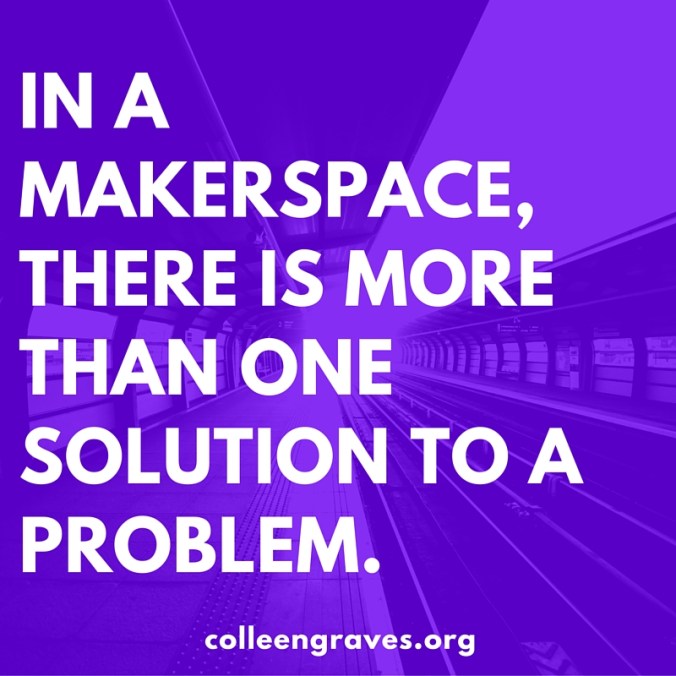
When teaching others about facilitating a makerspace, it is important to share that as maker librarians we should NOT give our makers “the” answer. We are here to build the path for them to explore and find an answer on their own. That personal road to discovery should also teach makers that there is more than one answer to a question and that there are many, many ways to solve a problem. In a makerspace, there is more than one solution to a problem.

In a makerspace, there is more than one solution to a problem.

Plus, if we don’t know, we can find out together. (Which reminds me of my last post, it is pertinent that we learn alongside our students.)  So, we set up a second set of bits with fans, and checked our temperature sensor to see the effect.

"Will the fan decrease the temperature?" #tcea16 @littlebits Let's find out! #library #makerspace

A photo posted by colleengraves.org (@makerteacherlibrarian) on

Take-aways from Leading the Learning This Week

Key phrases heard over and over this week by teachers and librarians at all sessions:

  • “I can do this!”
  • “Thank you for making this accessible.”
  • “I feel like I can try this!”
  • “I was scared of trying to incorporate a makerspace, but now I feel like I can do this.”
  • “Thank you for the time and space to explore!”
  • “I can’t wait to share this with my students!”
  • “My students are going to love this!”
  • “I can’t wait to see what my students do with this!”

So what does this mean for you, dear readers? Maker librarians, if you are wanting your teachers to collaborate with you on makerspace activities, you may need to set aside some time for your teachers to explore so they can make curriculum connections. If you are an administrator that wants this type of learning in your school, you need to give your teachers and librarians some hands on learning experiences. New to making educators? It’s okay (in fact, it is IDEAL) to learn alongside your students!